How many calories does MTB burn?
Mountain biking burns between 200 - 1400 calories per hour. Approximately 680 calories are burned per hour during moderate cross-country singletrack riding.

Does Chile have craft beer?
Chile has over 400 microbreweries and the ‘parent’ yeast of lager beer was found in Patagonia. Chile is famous for its wine, yet the craft beer scene has been exploding since 2008.
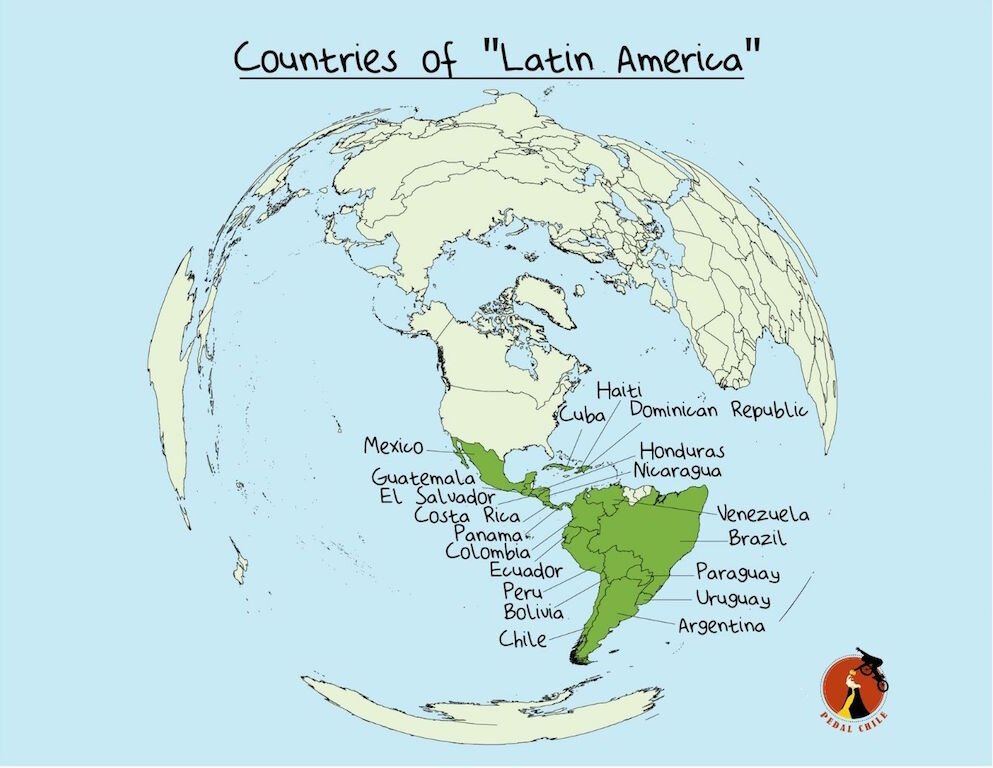
When most people think of Latin American beer, a clear, bland, and multinational brew comes to mind. For years that has been a stereotype, and a correct one at that. In 2020 is that stereotype still holding water? The answer depends on where in Chile.

Cerveza Bundor in Valdivia, Chile
An influx of German immigrants moved to Chile in the 19th century as part of a state-sponsored initiative to colonize southern Chile. Many of the beers today have a strong German influence, particularly those of Patagonia.
The Chilean Lake District (northern Patagonia) has over 40 microbreweries, including Kunstmann, which is the most famous.
In October of 2014, the local Union of breweries of Los Rios Region (UCR) was formed. This led to two partnerships with universities in Bavaria (Germany) that focus on the development of raw materials, specifically water for beer, cultivation of hops, and the development of regional yeast.
Beer from this region now carries a seal of origin and is known as ‘Cerveza Valdiviana.' This ensures you're getting a beer that was not only made in the Chilean Patagonia, but also from locally sourced ingredients.
The southern portion of Chile is known as a beer-culture, with the city of Valdivia commonly called the beer capital of Chile. More than 20 microcervecerias operate in Valdivia, including 3 breweries of award-winning beer. El Growler, Cerveza Bundor, and Cuello Negro combined for 9 of the 41 Chilean beers that medaled at the 2019 World Beer Awards.
Don’t know where or what “The Patagonia” is? If yes then great, if not check out this post from us.

Araucaria araucana in center of the picture. Our Why Pedal Chile page has interesting info that is only found in Chile. Like the full description of this tree.
A 2017 NBC news release reported that Archaeologist Dr. Alberto Perez excavated ceramic pottery remains that contained “traces of a yeast called Saccharomyces eubayanus — known as the ‘lost parent’ of lager beer.” The article also noted, “that might mean they were doing so using the yeast S. eubayanus to make alcohol more than 200 years before lager production began in Bavaria in the 1400s.” This ceramic artifact was located in the very northern section of “La Patagonia” on the Chile/Argentina border.
The study also reported “they have been commonly associated with Nothofagus, as well as Araucaria araucana,” both of these trees are native only in the southern section of South America. An article from Popular Science says “The Patagonian species is what gives lager yeast its interesting cold-tolerant and sulfite-metabolizing characteristics--characteristics that manifest in the distinctive flavor and character of lager beer.” This region of the world is home to over 2500 plant species that are endemic and cold weathered. The Mapuche, the indigenous people of the region also happens to drink a type of beer called chicha or corn beer. The Chileans generally call it chicha morada (morado = purple), since the corn is purple. Could this Chicha actually be the very first lager on the planet?
Interesting fact: Ale yeast is about 5000 years older than lager yeast.
In 1896 a German brewmaster opened a brewery in the remote town of Punta Arenas and gave it the name of Patagona. This brewery is the southernmost brewery in the world and is closer to Antarctica than the capital city of Santiago. In 1961 the brewery was sold, and renamed to Austral
Cervecería Austral is in the same location today as it was in 1896, which is right on the edge of the frigid Strait of Magellan and is the oldest continuously operated brewery in the country. The water source for all the beers of southern Patagonia is melted glacier water. Since water is the main ingredient in beer it has a huge impact on the overall flavor. The Austral Calafate is a hugely popular beer and uses the berries from the Magellan barberry, which is only found in the Southern Cone. The Calafate berry tastes like a flavor-enhanced blueberry.

Interesting note: Technically Austral Brewery is not the southernmost microbrewery since some small brewpubs in both Argentina and Chile are further south. However, it is a self-appointed title that has power due to the heritage and prestige of the Pataonga brand.
The northern Patagonia of both Chile and Argentina has the best beer culture in all of Latin America. This region has a combined 80+ microbreweries with 100% locally sourced ingredients. This region was primarily settled by German immigrants, who brought their brewmaster skills with them. This region offers the perfect climate for the cultivation of all the ingredients, including the ‘parent’ yeast. Even hops grow here.

Santiago, Chile
Santiago is the capital city of Chile with a southern latitude equivalent to Los Angeles. The largest city in Chile sits at close to 2000 feet above sea level and is surrounded by numerous mountain ranges, including the Andes. Santiago has 50 times more people than Valdivia, yet has fewer total microbreweries. Three breweries medaled at the 2019 World Beer Awards, Kross, Quimera, and Jester for a total of 7 awards.
Santiago is a classic Latin America megacity that still drinks the traditional lager style beers. The city is seeing greater demand for better beers, but compared to the rest of Chile, the beer culture is decades behind.

Street art in Valparaiso
In 2003, Valpo’s Historic Quarter was declared a UNESCO World Heritage site because “the colonial city of Valparaíso presents an excellent example of late 19th-century urban and architectural development in Latin America.” Valparaiso has over a dozen microbreweries just in the historic district alone.
In 2011 Copa Cervezas de América was started and is now the most important beer contest in Latin America. This week-long international event is great for sharing brewing knowledge and encourages the craft beer culture in Latin American. Daniel Trivelli, President of Copa Cervezas de América says “Sales of craft beer in Latin America are growing at between 20% and 40% a year, depending on which country ” and “here in Chile, sales are growing at 25%.”
Interesting info: It’s incorrectly believed that Andrew Blest established Chile’s first-ever brewery in 1825 in Valparaiso. La Chimba in Santiago was serving beer in 1822 and is referenced in numerous journals and periodicals of the time.

One of my favorite spots to drink a beer in Valdivia.
Most countries in Latin America have a hard time growing hops with climates that are generally too hot for growing. As a result, most brewers have to import hops from the US or Germany.
Things in Central and South America tend to be slower, and fresh produce can sit on the docks for weeks, which deteriorates the quality of the produce, and the final product. IPAs are not common, and on the rare chance that you happen to find one, after a couple of sips, you will wish you hadn’t. However, things are quite a bit different in Patagonia. This region offers an ideal climate to grow hops, and beers brewed in this region are able to use locally grown and fresh ones. Finding a great IPA in Valdivia, Osorno, Puerto Montt, or Bariloche is quite easy, with the most challenging decision being which one to select.
The microbrewery El Growler in Valdivia offers a handful of IPAs with hops grown right on the property. At the 2019 Word Beer Awards, El Growler took home 4 medals, 3 of which were for IPAs. The only other Chilean breweries to medal with IPAs were Cerveza Bundor*, and Cerveceria Coiron both also located in Patagonia. Is that a coincidence? I think not.
*Bundor is actually located on the street right behind El Growler in Valdivia. Both are on my top five list of best breweries in Chile.
The general consensus amongst cicerones (beer experts) is that most of South & Central America is 20 years behind the artisanal beer scene of the United States, with specific countries even further behind. However, the making of a craft beer culture is more than just about the product. This brings us to the question of will the craft beer scene ever catch up?
This post focuses on Chile, and in certain regions within Chile, namely Valdivia, and Patagonia the answer is the beer quality(beer culture) is fairly similar. For the rest of Latin America minus a few exceptions in Brazil and Argentina’s Patagonia the answer is maybe never.
Let look at a 2 barriers that have to be overcome in-order to bridge the gap to better beer.
Cold chain system - Many parts of the world don’t have refrigerated trucks or temperate controlled warehouses. Beer is perishable and if not stored and transported properly the quality suffers. Getting a good quality beer at the brewery only to find that same beer tastes awful from the liquor store happens all over South America. Chile has one of the better cold chain systems specific to Latin America but not compared to the U.S. or Europe.
Taxes - Chile doesn’t have any special taxes on craft beer or products with a higher volume of alcohol. However, many countries do, and overcoming this barrier generally comes in the form of passing the costs off to the consumer. If craft beer becomes a status symbol, as it has in certain countries, the ability to ever create a true beer culture is impossible.
The Lakes District of Chile has the best beer in Latin America (along with Argentinian Lake District). This region is abundant with natural beer resources, such as abundant sources of clean fresh-water, hops, and barley. This region was settled primarily by Europeans who brought their beer culture with them and it has allowed to flourish over the last 170 years in the perfect beer environment.

Jesse - Director of Pedal Chile. Jesse lives in the Patagonia and is an avid snowboarder, mountain biker, and reader of mostly non-fiction. Jesse has a Master of Science in Health and Human Performance and enjoys all forms of outdoor recreation. My favorite beer? Belgian style.
Related articles by Pedal Chile:

A study from Wilderness and Environmental Medicine tracked injuries from leisure activities over two years in the USA, using data from hospital tracking software. The researchers then calculated the injury rate for each outdoor activity. Here are the results:
Activity & injuries per 100,000 participants (injury rate):

The risk of injury is 7 times higher snowboarding than mountain biking
Swimming (1.5)
Fishing (2.4)
Mountain Biking (2.6) T
Water-skiing/tubing (2.6) T
Hiking/jogging (4.6)
Sledding/snow tubing (7.7)
Snowboarding (18.3)
From this data, the hiker injury rate is nearly double that of the mountain bikers.
Speaking from personal experience, I have suffered several injuries from hiking, but none to date from XC or singletrack riding. As in most recreational activities, injuries are determined by the choices of the participant more so than the specific activity.

Yes. Bicycle helmets significantly reduce the risk of injuries and severity. A professor in Norway analyzed 55 studies on cycling injuries from 1989 - 2017. What did he discover?
The author’s conclusion,
“wearing a helmet while cycling is highly recommendable.”
Ah, you think??
Head injury by 48%
Serious head injury by 60%
Traumatic brain injury by 53%
Face injury by 23%
Reduced fatalities or seriously injured cyclists by 34%
If you are looking for tips or helmet recommendations check out helmets.org.

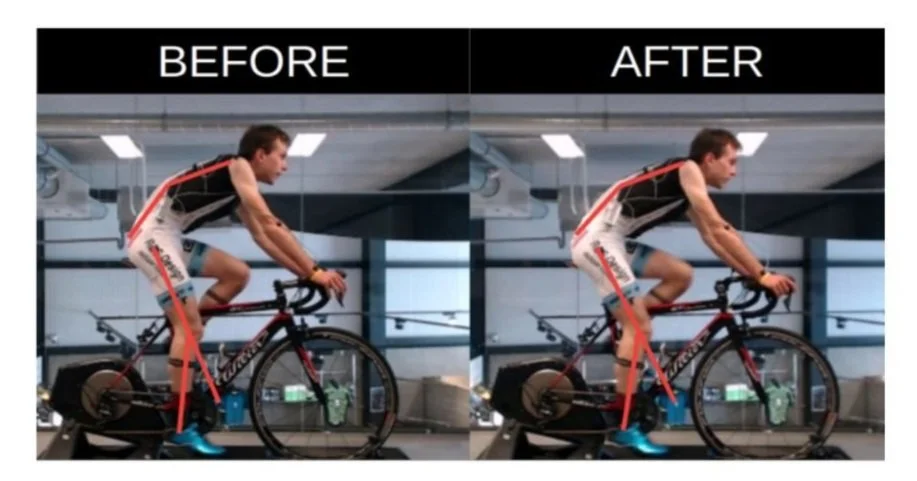
Ricardo (staff member) is making some adjustments
When most people think of injuries, the first thing that comes to mind is falls, crashes, or other accidents.
While these injuries can be the most severe, repetitive or overuse injuries can nag for years, and make any activity seem like a challenge. Back, knee, neck, shoulder, and butt are all common areas that exhibit pain in overuse type injuries.
One of the best and easiest solutions is making sure your bike is properly adjusted.
A 2010 study out of Austria studied mountain bike adjustments and overuse injuries. The biggest finding, “The inclination of the saddle and the saddle-pedal distance were responsible for 2/3 of the recorded syndromes.”
The position of the saddle is the crucial point in the bike’s adjustment.
Distance from the saddle to the handlebars is also very important.
Anterior inclination of the saddle between 10 to 15 degrees was recommended by the researchers
While proper bicycle adjustments prevent many injuries, it does take some expertise to get right. The study from Austria was studying professional mountain biker and 2/3 of these pros still had poorly adjusted MTBs. If you’re not sure how to properly adjust your bike, then seek out an expert in your area. Check-in with a local bike shop or look for a professional bike fitter.
In studies looking at injuries, hardtail riders commonly report more pain, particularly in the lower back. Hardtail bikes have significantly more vibrations and impact exposures than fullys. However, plenty of studies show that there is no difference between a hardtail and full-suspension bikes when it comes to vibrations and terrain impacts.
I like riding both hardtails and fullys. I let the trail dictate the bike I’m going to ride. Bike technology has come such a long way recently, and studies generally take time to catch up. My best guess going forward is that research will favor full suspension bikes in terms of comfort and a reduction in overuse injuries. However, not all trails require a full suspension and the lighter hardtails are nice for trails with long climbs and smooth descents.
A 2010 study from The American Journal of Sports Medicine published a study that looked at mountain biking related injuries in the United States during a 13-year period.
Of the near 5000 emergency room cases:
70% were due to falls
14% from going over the handlebars
Fractures accounted for nearly 30% of the cases
21 % from sprain and strains
While preventing accidents from happening is impossible, there are ways to prevent or minimize the vast majority of injuries. The most common are not even from falls, yet falls are oftentimes the most severe. Here are six ways to help reduce potential mtb injuries.

The yoga injury rate of 17.01 per 100,000 is 6.5 times more than mountain biking.
Avoid repetitive/overuse injuries. Muscle imbalances create a cascading effect of whole-body issues. It’s best to address these issues as they come up and avoid long-term chronic pain. Pedaling away while sitting in the saddle for hours on end can eventually lead to repetitive stress syndrome unless corrective action is taken.
Any activity can lead to overuse injuries if done frequently enough, including sitting at your desk. Check out our article on addressing muscle imbalances for cycling/MTBing.
According to the research, hiking causes 1.8 times more injuries than mountain bike riding. Why? Cyclists and MTBers are significantly less likely to suffer from stress fractures and muscle tears. However, repetitive stress syndrome of the shoulder and knee are prevalent in participants.
“More participants are injured from hiking than mountain biking (1.8 times more) ”
The vast majority of mountain biking injuries are either the direct result or caused partially from improper bike fitting. This is one of the easiest solutions, yet many people don’t seek out a professional to properly fit the bike. Also, is your bike set-up for maximum performance, or safety? Unless you are a racer, having your bike adjusted for safety is far more important and will help ensure years of fun on your mtb.
“The majority of mountain biking injuries are from overuse, and most of these are preventable with proper bike adjustments”
No one plans on falling, yet it happens. Wearing a properly fitting bike helmet and wearing gloves specifically designed for MTBing is essential. Some riders use knee/elbow pads, chest protectors, full-faced helmets, and mouth guards. This gear is generally reserved for the bike-park or pure downhill biking in a ski area. Wear what makes you feel comfortable, but not so comfortable that you think you're invincible.
Mountain biking like every sport/activity takes time to practice to improve. Riding with friends on advanced terrain is fine, as long as you dismount for sections that are clearly for expert riders only. The majority of ski/snowboard injuries I see are from people that are on runs they shouldn’t be on. Singletrack is different. If a section or two throws you out of your comfort zone, simply dismount and walk your bike.
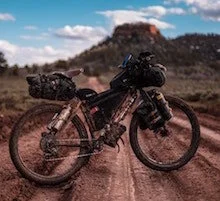
Epic trip! Next….full bike inspection and service
The number of injuries suffered from poorly maintained bikes is relatively unknown. However, I discovered one study from the ’90s that estimated 13% of all bike accidents were due to faulty equipment. Regular maintenance of your car is important, as is the routine service of your bicycle.

This is Lu (staff member) and her pretty bike. Prob not the best for singletrack though.
The worst crashes that I have witnessed all involved bikes that should not have been on that specific trail. Unless you are trying for an epic fail video, riding a huffy from the 80s down advanced singletrack is only going to lead to an epic crash
Bike's equipped with hydraulic brakes, tubeless tires, dual suspension, a dropper post, and 29-inch tires perform significantly differently than ones with lesser parts. While top-end mountain bikes are expensive…….you get what you pay for.
For more information, click here

Jesse is a director for Pedal Chile and lives in Patagonia, Chile. In addition to being an avid singletrack rider, this author is a lover of all books. Jesse has a Master of Science in Health and Human Performance and a Bachelor of Science in Kinesiology.
Carmont, M. (2008). Mountain biking injuries: a review. British Medical Bulletin, 85(1), 101-112. doi: 10.1093/bmb/ldn009
Flores, A., Haileyesus, T., & Greenspan, A. (2008). National Estimates of Outdoor Recreational Injuries Treated in Emergency Departments, United States, 2004–2005. Wilderness & Environmental Medicine, 19(2), 91-98. doi: 10.1580/07-weme-or-152.1
Høye, A. (2018). Bicycle helmets – To wear or not to wear? A meta-analyses of the effects of bicycle helmets on injuries. Accident Analysis & Prevention, 117, 85-97. doi: 10.1016/j.aap.2018.03.026 link
Nelson, N., & McKenzie, L. (2010). Mountain Biking–Related Injuries Treated in Emergency Departments in the United States, 1994-2007. The American Journal Of Sports Medicine, 39(2), 404-409. doi: 10.1177/0363546510383478 link
Sabeti-Aschraf, M. (2014). Overuse Injuries Correlated to the Mountain Bike`s Adjustment: A Prospective Field Study. The Open Sports Sciences Journal, 3(1), 1-6. doi: 10.2174/1875399x010030100001
Swain, T., & McGwin, G. (2016). Yoga-Related Injuries in the United States From 2001 to 2014. Orthopaedic Journal Of Sports Medicine, 4(11), 232596711667170. doi: 10.1177/2325967116671703 link

Most studies looking at the environmental impact of mountain biking compare it with hiking. According to the research, the two activities have a similar minimal-impact on our environment.
The author/professor(s) is a hiker (non-mtber) and their research is motivated in part by their dislike for mountain bikes. Numerous research papers ‘studying’ the supposed environmental impacts of ‘mountain bike riding’ cite numerous social stereotypes instead of environmental issues.
A 2010 paper titled “The Problem of Mountain Biking as Leisure and Sporting Activity in Protected Areas” is a clear example of ‘non-biased’ research. In this paper, the author says, “hikers and those peoples seeking authentic natural experiences” are “concerned that mountain biking is not an appropriate leisure activity in protected areas.” I never thought my mountain biking moments were less than ‘authentic.’
After these ‘scientists’ are unable to find any discernible environmental differences between hiking and mountain biking they generally conclude by saying that mountain biking is difficult to access due to ‘limitations in quantitative experimental methods’ or something obtuse and wrapped up in scientific gibberish.

Looks fun….Not for the macrofauna who just perished.
A study from the Journal of Coastal Conservation researched the effects of human trampling during beach volleyball and the survival rates of four intertidal macrofauna species. The researcher’s conclusion, “beach games may have a damaging effect” and “trampling has some impact on sandy beach macrofauna.” It should be noted that fat-tire mountain biking has minimal impact on the macrofauna that were studied in this paper.
The majority of studies looked at impacts from erosion, disturbances of wildlife, tree/plant damage, littering, water quality, fire rings, and excessive muddiness. None of the studies looked at the entire environmental equation but instead focused solely on the ecological impacts.
What about the energy consumption and materials used in the manufacturing process of hiking and biking equipment?
How do these hikers/mtbers get to the trailhead?
Are mountain bikers more likely to commute by bicycle?
What about the impact of hikers displacing natural habitats in-search of walking sticks? This list could go on and on…..
Birdwatchers are amongst the worst when it comes to ecological disturbances.
A 2014 study from Environmental Management said: “Birdwatchers tend to go where the birds are, which means they often go where no infrastructure is available, intruding into new areas and potentially pioneering new ‘tourist trails’.”
Only the least environmentally conscious MTBers leave-trail, but in birding, it’s commonly accepted and expected. This same study also noted that some birdwatching trips visit destinations that are “considered toxic for humans.” One doesn’t have to be an environmentalist to appreciate boundaries. I love riding singletrack, but the thought of blazing a new trail to peep on some bird never crossed my mind.

No habitats were destroyed for this picture.
“
Hikers exert 4 times more trail pressure than mountain bikes ”
An issue of significance is the paradox of protection of natural ecosystems while promoting recreational opportunities in these protected areas as long as it’s in alignment with agreed-upon social activities.

A 2010 study looked at wildlife disturbances of heli-skiing and military helicopters on the nesting and reproductive rates of golden eagles in northern Utah.
The article noted that “golden eagles also have attacked small fixed-wing aircraft and helicopters.” However, the researcher's conclusion, “no discernible effect on golden eagle nesting success or productivity rates."
If a Boeing AH-64 Apache helicopter doesn't disrupt natural animal habits than my mountain bike must resemble a friendly neighbor rolling over to say, “hello, let's share this 6-pack of local brew."
Many mountain bikers/cyclists get categorized as ‘adrenaline junkies’ as opposed to a nature-based hobbyist.
This distinction creates a divide amongst outdoor enthusiasts. The vast majority of single-trackers that I know enjoy being immersed in nature. Is it our fault that we just happen to have a hell of a lot more fun on the way down?

A 2010 study compared the env. impacts of hiking, mountain biking, and horse-riding. MTBers and hikers had near-identical results. The horse-riding group had significant impacts, especially with “nutrification of soils and waterways from horse manure and the spread of weeds.”
This study also noted that the pressure per area for a horse plus-rider is 10 times greater than a hiker.
A mountain biker with high-profile tires will exert maximum pressure of 14 kg/cm2 on the trail when riding uphill
Walkers exert maximum pressure of 56 kg/cm2 when descending a hill
The author also said, “On level ground, however, walkers reach comparable and often higher pressures than mountain bike riders.”
The aforementioned study of horse-riding says the extra pressure is responsible for the greater impacts compared to the hiking and mountain bike groups. What about the fact that trail-walkers exert higher forces than MTBers?
A horse trots at about 8 mph on average. The average speed for singletrack riders is about 7 mph and 16 mph for road cyclists.
Any group of outdoor recreationalists can have a negative ecological impacts if ocular consumption is the primary reason for the activity.

If getting ‘the picture’ is more important than the experience itself…….it’s probably ocular consumption.
While mountain biking, I’m not thinking about pictures…. I don’t want to dismount……Singletrack riding is just soooooo much fun! There is nothing wrong with taking pictures, except when picture-taking compromises safety or the health of natural ecosystems.


Jesse is the Director of Pedal Chile and lives in La Patagonia (most of the year). Jesse has a Master of Science in Health and Human Performance and enjoys MTBing down the singletrack on the active volcano in Chile’s Patagonia.
Burgin, S., & Hardiman, N. (2012). Is the evolving sport of mountain biking compatible with fauna conservation in national parks?. Australian Zoologist, 36(2), 201-208. doi: 10.7882/az.2012.016
Goeft, U., & Alder, J. (2001). Sustainable Mountain Biking: A Case Study from the Southwest of Western Australia. Journal Of Sustainable Tourism, 9(3), 193-211. doi: 10.1080/09669580108667398
GRUBB, T., DELANEY, D., BOWERMAN, W., & WIERDA, M. (2010). Golden Eagle Indifference to Heli-Skiing and Military Helicopters in Northern Utah. The Journal Of Wildlife Management, 74(6), 1275-1285. link
Moffett, M., McLachlan, A., Winter, P., & De Ruyck, A. (1998). Impact of trampling on sandy beach macrofauna. Journal Of Coastal Conservation, 4(1), 87-90. doi: 10.1007/bf02806494
Pickering, C., Hill, W., Newsome, D., & Leung, Y. (2010). Comparing hiking, mountain biking and horse riding impacts on vegetation and soils in Australia and the United States of America. Journal Of Environmental Management, 91(3), 551-562. doi: 10.1016/j.jenvman.2009.09.025 link
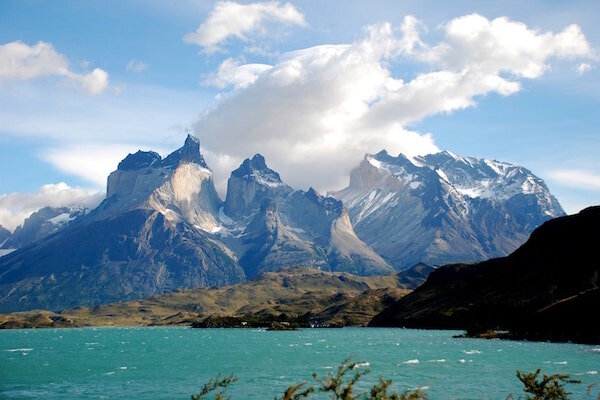
Where and what is The Patagonia?
Patagonia is neither a nation nor a specific province but is a region comprising of all southerly Chile and Argentina.
Is Patagonia big? Patagonia is 347,627 square miles. Approximately twice the size of Italy.
This makes Patagonia larger than over 80% of the nations of the world.
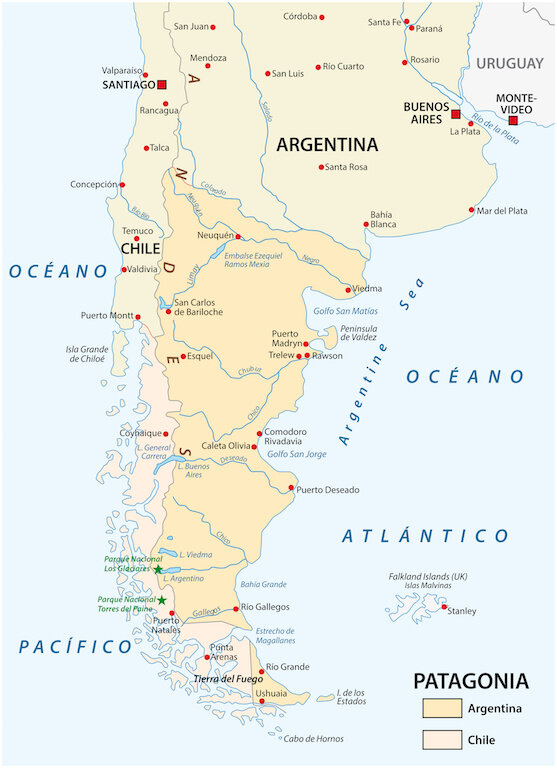
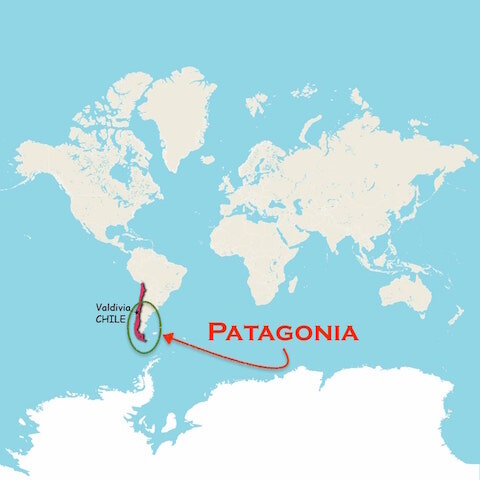
Patagonia is one of the most famous places in the world, yet no two people can seem to agree where it starts.
Finding a definite area has been a challenge. But after weeks of research, this riddle has been solved. The rest of this article follows my journey to discovering the boundaries of South America’s Patagonia.

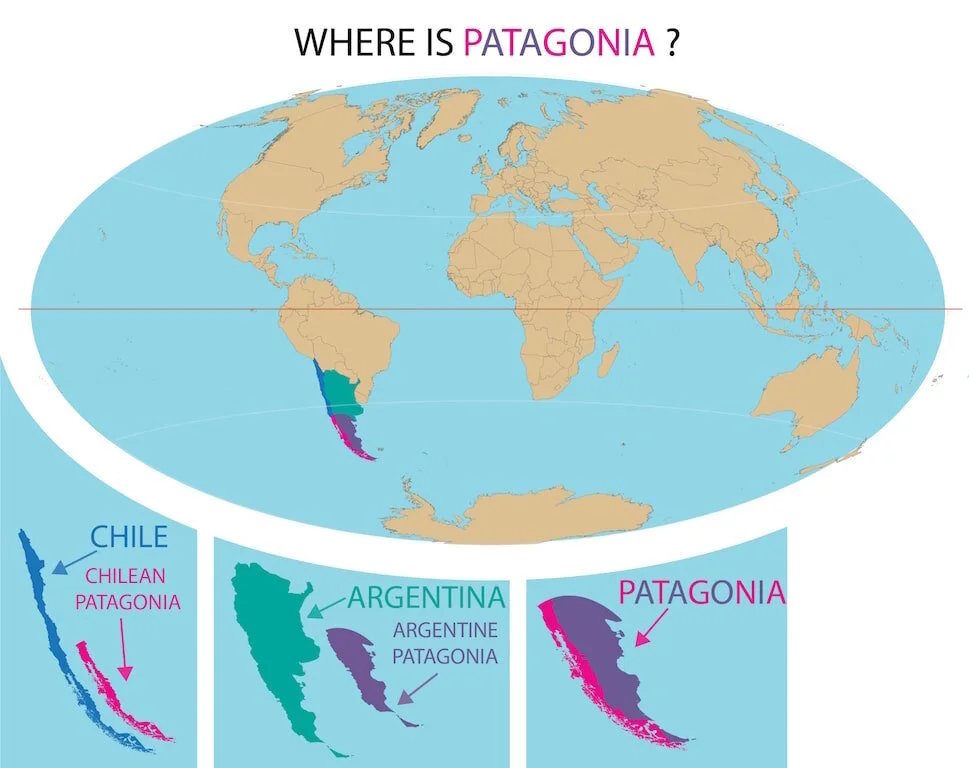
A simple Google search will turn up just as many answers as results. Most Chileans say south of Puerto Montt (textbooks in Chile teach this). Many Argentinians will say everything past Bariloche.
With all the confusion I decided to contact some experts. I reached out to the Chilean and Argentinian governments. The Embassy of Argentina said, “it’s a geographic region and not a defined province of Argentina.” I basically got the same response from the Chilean government. Was this a diplomatic answer from politicians?
Next, I emailed GoChile, which is the largest travel website in Chile. GoChile says:
“La patagonia esta al sur de Chile y Argentina.”
This roughly translates to:
“The Patagonia is in the South of Chile and Argentina.”
Was this helpful??? Maybe. This is the same response I got from both government offices.
Next stop…..Wikipedia…….Wikipedia says Patagonia is the “region at the southern end of South America shared by Argentina and Chile”.
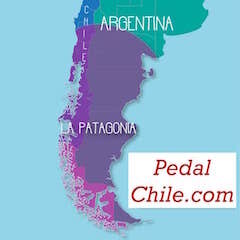
Wikipedia defines the boundaries as:
The Pacific Ocean to the west
The Atlantic Ocean on the east
Southern border: Straight of Megellan, the Beagle Channel and the Drake Passage
Northern limit:
Colorado & Barrancas River in Argentina
Huincul Fault in Araucania Region
To simplify this for people that are unfamiliar with these places. Wikipedia is basically saying:
The Chilean Patagonia goes from Temuco to the tip of South America
The Argentinian Patagonia is everything south of Neuquén
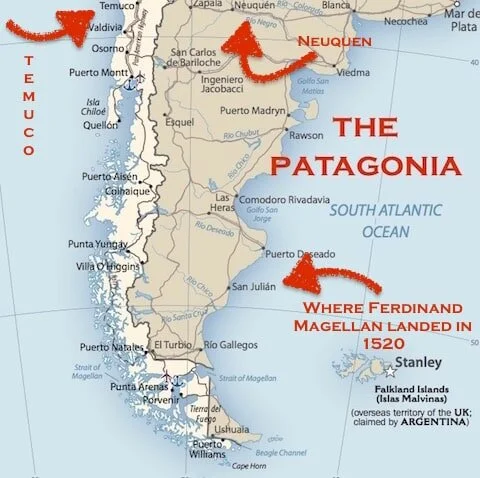
This map is the commonly accepted area of Patagonia
The Colorado River valley and Barrancas River, which reach the Atlantic Ocean about 50 miles south of Bahia Blanca. This natural river border is commonly considered the northern limit of the Argentinian Patagonia. Neuquén, which is the largest “commonly” accepted city in this sector has a current population of around 340,000 people.
Temuco, which some maps show as the largest city on the Chilean side, has a population of approximately 220,000 people. These two cities house over a half million people in what could more accurately be described as a concrete oasis.
Neither one of these cities would ever be confused as the Patagonian entry point in their respective countries. Read any guidebook to Argentinian Patagonia and none of them will suggest Neuquén. Some will recommend Puerto Madryn or San Carlos de Bariloche for entry to the northern section.

After getting no clearly defined areas from both governments, I decided to do some research at the library.
In the book Geografia Historica de la Patagonia (The Historical Geography of the Patagonia) noted Argentinian historian Raúl Rey Balmaceda says:
“If we look at a map of South America, we can note that the region designated with the name Patagonia covers the narrow strip on the Chilean coastline south of Valdivia, the Patagonian Mountains, and the ledges and terraces that descend from them towards the Atlantic Ocean” - Raúl Rey Balmaceda
Enrique Campos Menéndez, from his book, The Soul of Patagoina, says:
“39° and 59° of southern latitude in South America, made up by one million square meters of mainland territory and surrounded by two great oceans - the Atlantic and the Pacific - and an archipelago of channels and fjords that make up the bottom cone of the continent.” - Enrique Campos Menéndez - Chilean Writer (el Ama de la Patagonia)
“The name Patagonia is here applied to the country extending from the line of the Rio Negro, about latitude 40° south, to the Straits of Magellan; and is bounded on the east by the Atlantic Ocean”
Where is 39° degrees latitude?
Valdivia in Chile and Neuquén in Argentina (the northern limit).
What about 59° or the southern limit?
59° is the southern latitude coordinate for the Drake Passage.
This passage connects the Pacific to the Atlantic Ocean.
All these historians agree, but maybe they just agree from years of studying the same outdated maps?

Drake Passage at 59 degrees South Latitude
“Historically, the traditional boundaries of Patagonia are well known, but the subject continues to be debatable considering recent archaeological discoveries and the availability of more in-depth and widely publicized investigation in modern times ”

Author Jaime Said is 100 percent correct. Look at any map that predates the independence of Chile and Argentina and it has clear and defined borders. The issue got complicated once Chile and Argentina started to explore the region shortly after they both achieved independence.
The first treaty that focused on the border issue was signed in 1856. The issue now became what country was Patagonia in. Even today, looking at local maps of the southern Patagonian area, one will find places that both countries claim. Los Glaciares National Park is an interesting example.
The borders have been fought over for years. The main issue is related to WATER.
“The vital natural resources located in these glaciers, which is key to the development of people’s lives, both for daily consumption and the economic activities of such great importance on the eastern side, such as agriculture and livestock”

Los glaciares National Park - Argentinian Patagonia.
After hours of research, emailing, and scouring the web, I finally stumbled upon a brochure from Parque Patagonia. The following quote is taken directly from this brochure.
“The name “Patagonia” evokes images
of a wild, untamed place, but drawing the exact borders of Patagonia is a challenge. It is neither its own nation nor a specific province but in general has come to mean the region comprising all of southerly Chile and Argentina.”
The governments of Chile, Argentina, and the GoChile website were exactly right. For both Argentina and Chile, Patagonia is not a single providence or county and only came to be regarded as a political region during the last century. Since Patagonia is located in both Argentina and Chile it has no provincial or territorial ownership.
To say the borders are irreverent would be naive, considering border disputes have been ongoing since the 1850s. The average person has heard of Patagonia but placing it on a map would prove to be a challenge.….just point to the far south of South America and you will be correct.
Image Source: Wikimedia Commons
This origin story has several different versions. The simplest version is generally the correct one. In 1520 Ferdinand Magellan landed in what is now Puerto San Julián, Argentina. At the time a book called Primaleon was very popular.
This book (the Spanish edition was printed in 1512), featured a race of wild people called the Patagonians. In the book, the hero Primaleon sails off to a faraway land. The natives in this “new” land eat raw flesh and wear animal skins.
This sounds almost identical to the tales that were told years later. Magellan encounters a group of natives and their natural way of living. The fantastical novel resurfaces in his mind, and we now have a real-life Patagonia.
For an in-depth look at the origins of the word ‘Patagonia,’ check out my article on the place-name history of ‘La Patagonia’

Jesse is Director of Pedal Chile and lives in Valdivia, Chile (most of the year). Pedal Chile is an all-inclusive mountain bike tour company based in Chilean Patagonia. Jesse is an avid MTBer, snowboarder, non-fiction reader, and blogger.
Sources for this article:
“Argentina - the World Factbook.” Www.cia.gov, www.cia.gov/the-world-factbook/countries/argentina/.
“Chile - the World Factbook.” Www.cia.gov, www.cia.gov/the-world-factbook/countries/chile/.
Holz, Andrés, et al. “Fires: The Main Human Impact on Past Environments in Patagonia?” Past Global Change Magazine, vol. 24, no. 2, Dec. 2016, pp. 72–73, 10.22498/pages.24.2.72.
Lieutenant Musters (1872). On the Races of Patagonia. The Journal of the Anthropological Institute of Great Britain and Ireland, Vol. 1, pp. 193-207.
Manzano Iturra, Karen Isabel. "Representaciones geopolíticas: Chile y Argentina en Campos de Hielo Sur." Estudios Fronterizos, vol. 17, no. 33, 2016, p. 83+. Gale OneFile: Informe Académico, Accessed 6 Jan. 2020. Link
“Patagonia.” Wikipedia, 19 Jan. 2021, simple.wikipedia.org/wiki/Patagonia.
Said, J. (2014). Patagonia. Penguin Random House Grupo Editorial Chile.
Webb, Kempton E, and Emilio Fernando. “Patagonia | Map & Facts.” Encyclopædia Britannica, 26 Oct. 2018, www.britannica.com/place/Patagonia-region-Argentina.
By: Pedal Chile

Atacama Desert in northern Chile
Chile is home to one of the most pronounced climate gradients on planet Earth. Chile is a mecca of biodiversity and unsurpassed beauty. Let’s see some photos!
The driest desert in the world. The water here is measured in mm per decade, not per year. The Atacama Desert even receives less precipitation than the polar deserts. This desert spans 600 miles, making it about 100 miles longer than the entire state of Florida. Fun Fact: The oldest mummy in the world has been found here, predating the Egyptian mummies by thousands of years.
This area and other parts of the Atacama Desert have soil samples that resemble those taken from Mars. NASA uses this area to test equipment before blasting off to the red planet.

Chile’s largest national park and contains the famous Towers of Paine and Grey’s Glacier. This was declared a UNESCO Biosphere Reserve in 1978.

Chile has approximately 500 active volcanoes and Volcano Villarrica is the most active of them all. Day hiking or mountain biking this route is truly one epic experience. The trail passes through a temperate rain forest, fresh lava flows, and barren ash fields.

In 1995 this tiny island was declared a UNESCO World Heritage site. Chile annexed this 64 square mile island in 1888.

In 2011, Chile created Parque Pingüino Rey ( Penguin King Park) in Inútil Bay, to protect the only colony of penguins in all of Latin America. This is also one of the only colonies outside of Antarctica.

The ALMA (the Spanish word for soul) Telescope is located in the northern Chilean desert and sits at 16,500 feet above sea level. You don’t need to use the 1.3 billion dollar telescope to get out of this world star gazing views though (as you can see from the photo below).


Out-exercising a bad diet and adding strength to an already over-developed muscle were the two biggest obstacles I faced back in my personal training days. Most of what I read preaches about the importance of squats and lunges for mountain bikers and cyclists.
Adding strength to an area of strength is the cornerstone for developing overuse and repetitive injuries. Spending hours in the saddle hunched over, while pedaling can lead to all sorts of muscular imbalances. Addressing these imbalances is significantly more important for your bike performance and health than simply adding in a couple of squats or lung variations.

Corrective exercises and cross training are your two best options:
Corrective exercises: Movement or exercise designed to fix a dysfunction.
Cross training: Athletic training in sports other than the usual sport or activity.

The causes of overuse injuries from mountain biking are similar to those from running, muscle imbalances and inflexibility.
Calves
Quads
Hip flexors
Chest
Traps
Neck flexors - from forward lean
Abs
Butt
Mid-back
Rotator cuff muscles
Neck extension muscles
The days of stretching tight muscles and strengthening weak muscles are over. Overactive/underactive muscles are reflections of muscle imbalances. Overactive muscles are not necessarily strong and tight. Underactive muscles don’t mean weak and lengthened. Just stretching a “tight” muscle for 30 seconds is not a solution.
I had a four-year period where I averaged over 230 plus miles of riding per week, and the only thing that kept me healthy enough to ride was a daily dose of corrective exercises. The cascade of imbalances that get set into motion from prolonged time in the saddle can be dramatic.
Pain is a signal, and like all signals, the pain is trying to relay a message to you. Often times the location of the pain is not the source of the pain. The human body is one big intertwined network of the fascia.
All the exercises below are from Pete Egoscue’s book: “Pain Free ”. Pete Egoscue combines chiropractic, Feldenkrais, physiotherapy, pilates and other techniques into one modality. His book is easy to understand and the simplicity of the exercises are easy to implement and can be done at home while watching TV.
These are the best corrective exercises for mountain bikers. You can YouTube these exercises for a demo. The Internet is already filled with perfectly good videos, so I’m not going to add any more to the World Wide Web.
Cats and dogs – 10 to start
Floor twist 1 min each side
Groin Stretch – 5 min per side
Static extension – 1 min
Floor sit – 2 min
Foam-roll the quads and calves
These exercises should be done daily or at least every other day. This takes under 10 minutes and can be completed during an episode of your favorite show.

Example of cross-training….Volleyball
Ideally, this other sport or activity should be as close to the opposite of riding a bike as possible. Mountain biking doesn’t require legs to be fully extended and doesn’t use any lower-body lateral movement.
Swimming, racquet sports, basketball, volleyball, surfing and hiking are examples of good cross-training activities. Sports that address the areas of under-activation are a fun and practical way to remedy these imbalances, without having to spend much time using corrective exercises.
Hiking: This green exercise is one of the best choices for mountain bikers in the off-season or for cross-training purposes. Hiking is comparable in total calories and level of energy. The muscle activation pattern diffs, which is exactly what you want to help re-balance and correct any muscle imbalances you created from mountain biking.
Racket sports: Like mountain biking, racket sports are high-intensity interval training (HIIT) sessions. A sudden short burst of energy followed by periods of rest. The lateral movements and lunging action of reaching for balls are exactly what you need after a season of linear pedaling.
Anaerobic power or maximal power is when you go all out. Road cycling is generally around 98% aerobic. However, depending on the single-track, many MTB trails are steep enough that you’re working above your body’s aerobic capacity on the majority of climbing sections.
Exercises to improve hill climbing:
Sport-specific: Hill training on your MTB/road bike
Find a big hill near your house and cycle up
Work your way up to 3 rounds of 2 minutes each (2-3 times per week)
Can also use an indoor bike by increasing the resistance
Gym exercise:
Load the leg press with 40% of your one-rep-max and do as many reps as you can in two minutes (work your way up to 3 rounds of 2 minutes each, 2-3 times per week)
Sled pushes (same set and rep scheme as above)
Mountain biking requires you to constantly change body positions as your riding over rough and varied terrain. Your body positions change while pedaling over obstacles, rock gardens, roots, stumps, and while traversing rocks.
In order to improve climbing, descending, and cornering you will need to optimize your balance, as your posture is constantly adapting to the diverse terrain. Especially during downhill sections, where strong shocks and rapid changes of direction pushes your balancing skills to their boundaries.
Power is a function of balance. As we age our strength and endurance are relativity stable for years, but our muscular power (force x velocity of muscular shortening) declines rapidly, starting in our 30s.
High-velocity resistance training as opposed to traditional strength training is needed to increase your power output and improve your dynamic balance.
Studies show that 12 weeks of explosive heavy resistance training is highly effective to improving power and dynamic balance:
Leg press:

3 sets of 8 at 70% of 1RM (one-rep-max)
Up-phase as fast as possible
Controlled lower (one-second down)
Pause for one-sec at the bottom
Push-up:
3 sets of 8
Up-phase as fast as possible
Controlled lower
Pause for one-sec at the bottom
You don’t even need a gym membership. Home exercises that emphases explosive power are even better than leg presses done at the gym:
Weighted-vest stair climbing/running
3 sets of 4 flights of stairs 3 times per week
No weighted-vest for first week. Each subsequent week you should add weight to your vest (the principle of progressive overload)
Unlike in cycling where aerodynamic (aero) drag is the primary force that works against you, gravity in mountain biking is your greatest challenge.
So what is the best way to improve your power to weight ratio? Depending on how much you weigh…slimming down could be the main focal point of your training and nutrition regiment.
In speed camps for athletes, those that have 10% body fat or more, the main training mechanism for speed improvements come from losing body fat…..as this is the best way to improve power to weight ratio…..mountain biking is no different.
If you incorporate the power and anaerobic training exercises from above, they will improve your muscular power and help with fat reduction. If you are 15+ pounds over-weight, then weight-loss through dietary means should be your number one priority for increasing your power to weight ratio.
We all enjoy riding singletrack and other trails. But nothing derails a ride like being injured. Keeping the body in prime bike condition through corrective exercises/cross-training while preventing overuse or repetitive type injuries is imperative to continued fun.
If you looking to improve your climbing, then you should focus on improving your power to weight ratio and increase your maximum power output.

Jesse is the Director of Pedal Chile and lives in La Patagonia. Jesse has a Master of Science in Health and Human Performance and a Bachelor of Science in Kinesiology. Hobbies: Mountain biking, reading, researching, weight-lifting, craft beer and snowboarding.
Additional articles from Jesse at Pedal Chile:
Meditation is becoming more popular and for good reason. However, what exactly is meditation and how to incorporate it into one’s life is a topic of much discussion. The ancient practice of meditation has been around for thousands of years, yet somehow has become more complicated and mystical.

1) Find a comfortable place free from distractions.
2) Sit in a comfortable position, which can include sitting in a chair.
3) Put the cellphone on silent, except for the timer, and set to 10 minutes.
4) Close your eyes.
5) Do nothing.
6) When thoughts pop into your head don’t attach any meaning to those thoughts, just let the thoughts flow by. When another thought pops into your mind let that flow by as well. Before you know it the thoughts will become less frequent and in the meantime you will be present “be here now”(so to speak).
7) Don’t check your phone or do anything else until the timer goes off.
You will read books or hear about following your breath or repeating a word over and over. These are different mediation techniques, which you may choose to incorporate at some point. However, if you are not yet in a routine, the simple seven steps is a great place to start.
Give this a try and let me know how it goes! Good luck.