cycle1

Why is Latin America Called Latin America?

Chilean Patagonia of “Latin America”

Chilean Patagonia in “Latin America”


Like most other people worldwide, you may have asked yourself the following questions at least once:

  1. Which people are Latin Americans?

  2. Where is Latin America?

Or

3. Why are certain people referred to as Latin Americans, yet they don’t speak Latin (or do they)?

And if you are often curious like me, you must have even wondered where the term came from! If you have, then keep reading!

This article brings to you the facts about this elusive term that has been confusing nearly everyone including government agencies in the U.S and beyond for decades.

Let’s begin!

What is Latin America?

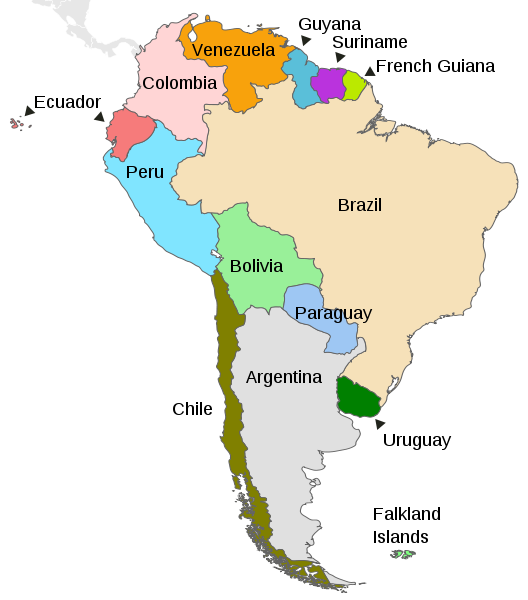
countries of latin america map.jpg


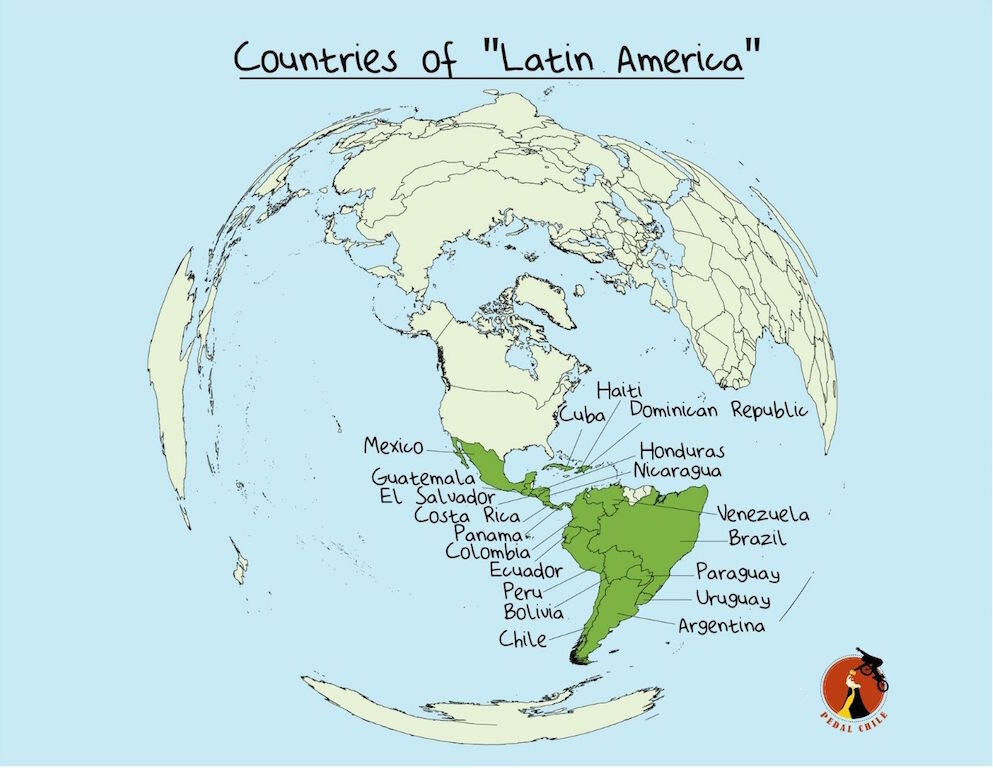
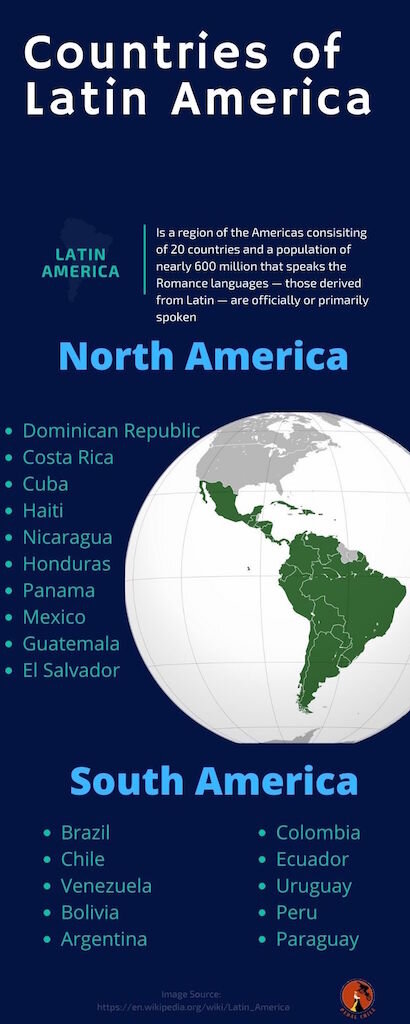
The term “Latin America” is not used consistently by geographers or geopolitical experts. However, The United Nations Latin American and Caribbean Demographic Centre (CELADE) limits its definition of Latin America to 20 countries:

  • The 10 Spanish-and Portuguese-speaking countries of South America

  • The 6 Spanish-speaking countries of Central America

  • Mexico

  • Cuba, the Dominican Republic, and Haiti in the Caribbean region


Here’s a more detailed list of the individual countries:
 
Countries of Latin America updated.jpg

Latin America: Defined

Latin America has always been difficult to define to most people, and you’ll sometimes hear it being considered a geographic region that includes the whole Caribbean- that is, all the countries in the Western Hemisphere, south of the United States (regardless of the language they speak).

Other experts define it as a region in which Portuguese, Spanish or French (the Romance languages) are predominantly spoken, or as countries that have a history of Iberian (Portuguese and Spanish) colonialism.

The origin of the name “Latin America”

The romance languages (group of languages that belong to the Indo-European family of languages including:

  • French

  • Italian

  • Romanian

  • Spanish

  • Portuguese

  • Occitan

  • Catalan

  • Rhaeto-Romanic (originated from Vulgar Latin)

    • Vulgar Latin simply refers to a “later” or “popular” form of Latin whose style is a bit different from the original “classic” (standard) Latin.


Panama City, Panama

Panama City, Panama


This means that these languages fall under the name Latin America due to this origin.


Latin America & Colonialism

Latin America, like many names in the Western Hemisphere, hails from a legacy of colonialism.  As you may recall, during the 18th and 19th centuries, different countries in Europe grabbed different lands around the globe in efforts to establish their empires.

  • During this period, Latin America stemmed from a desire to separate countries speaking French, Spanish, and Portuguese from the ones that were speaking German, English, or other languages.

French association?

You may find it ironic that Latin America tends to be associated and identified with Spanish even though its origins are more closely tied to the French.

In the United States, the first known reference to a Latin race came from a French economist known as Michel Chevalier in the 1830s. A couple of decades later, the term appeared in writing during a Paris conference held by Francisco Bilbao, a Chilean politician.

According to many history experts, French intellectuals popularized the terms to refer to the people living in the Western Hemisphere’s former Iberian colonies. They were seeking to justify the imperial ambitions of their country (France) in the New World by highlighting that the Latin race members, including the Central Americans, Mexicans and South Americans had an “innate affinity” with the French, and that these people have been locked in a world struggle against the expansionist U.S and Great Britain.

Southern Hemisphere & The Americanos


Image Source: Wikimedia Commons

Image Source: Wikimedia Commons


Did the people of the Southern Hemisphere identify themselves with the Latin race?

No. Initially, they preferred the terms Americanos and America, and these terms were prevalent in the 1810-1820s when the region was waging liberation wars against Spain. As a result, “Americano” developed an anti-colonial meaning and didn’t just encompass Europeans but Africans and mixed-races.

When U.S expansionists began threatening Mexico in the 1830s, Central and South American elites adopted “Hispano-America” to distinguish themselves from the U.S societies.

In the late 1840s, the Southern Hemisphere elites began identifying themselves with the Latin race, and some of them were influenced by Francisco Bilbao who I mentioned earlier. The term was used as early as 1845- in Spanish America when the editors of a Mexican paper stressed that they were members of the Latin race. The term then became prevalent in Bolivia, and then Brazil and Argentina and elsewhere as Spanish American elites held concerns against U.S expansionism toward the Southern Hemisphere.

So, when did it become a concept?

Latin America became a global concept in 1856, during a protest against the expansion of the United States. The U.S president at the time, Franklin Pierce, made a decision to recognize a “piratical” regime that had been established by William Walker in Nicaragua.


William Walker (Image Source: Webster and Webster)

William Walker (Image Source: Webster and Webster)


Foreign governments were shocked by this decision and immediately sparked talk of war between the European powers in the Caribbean (France, Spain, and Great Britain) and the United States on both sides of the Atlantic.

However, later on, this development eventually led governments to create what would be considered the largest anti-US alliance in the history of Latin America after intellectuals and politicians throughout the region demanded it (when they heard of the U.S President’s decision to recognize William Walker’s regime).

The transnational campaigns that resulted from the alliance caused the concept of Latin American to spread across the continent. You’d be right therefore to say that one of the first anti-US events in history led to the rise of “Latin America.”

did Napoleon coin the term “Latin America”?
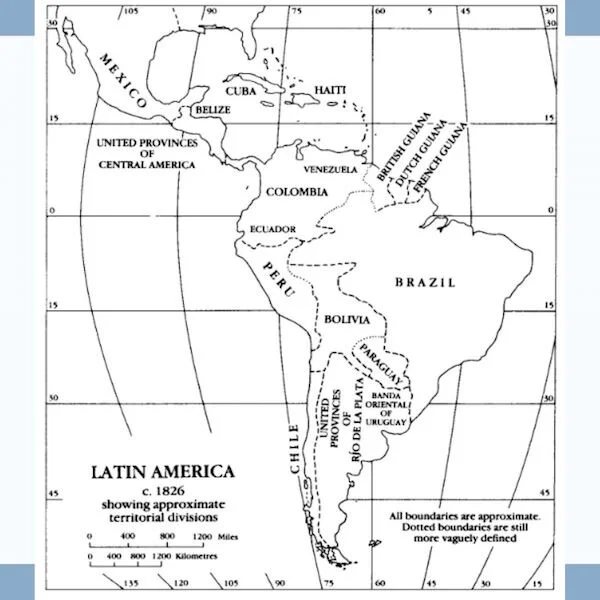

Map of Latin America circa 1826 (Image Source: Bulmer-Thomas)

Map of Latin America circa 1826 (Image Source: Bulmer-Thomas)


It always sounds amazing to hear that the man who reasserted the French influence around the world also coined the term “Latin America.” Wherever you go, it would be a rare spectacle to hear a story about the origins of Latin America without Napoleon at the center of it.

But is it true that Latin America is another one of Napoleon’s great “accomplishments?”

Or is it another historical whim that wouldn’t just leave our online history books?

Here’s the sweet-bitter truth:

Napoleon III did NOT coin the term “Latin America.”

Rather, the term was coined during his rule over France, however, the exact person is unknown. Unsurprisingly, this helped him in his campaign meant to imply a level of cultural similarity between the Latin American region (consisting of people who spoke Portuguese, French, and Spanish) and France that was aimed at assisting him to extend French imperial control over the entire region.

Who then first used the term?

A French man known as Michel Chevalier is the one who is often credited for the coinage of the term. In his writings, he postulated that a section of the Americas has a racial or cultural affinity with the romance cultures (such as Spanish, Portuguese, Italian, and French) in the 1830s. According to Chevalier, this part was inhabited by a group of people of a “Latin race” that could befriend what was at the time referred to as “Latin Europe.”

Latin American intellectuals and political leaders later took up the idea and yes, it became a thing!

Is Belize, Guyana & Jamaica part of “Latin America”?


central america & independence .jpg

 
The expression “Latin America” whose origin is still hotly disputed, at first had little more than geographical significance - it referred to all those independent countries south of the Río Grande in which a language derived from Latin
— From the book: "The Economic History of Latin America since Independence"


Some ‘experts’ consider English speaking countries to be part of Latin America.

Some ‘experts’ consider Belize, Guyana, and Jamaica to be part of Latin America. Even though the official language is English in all three of these countries and all are former British Colonies.
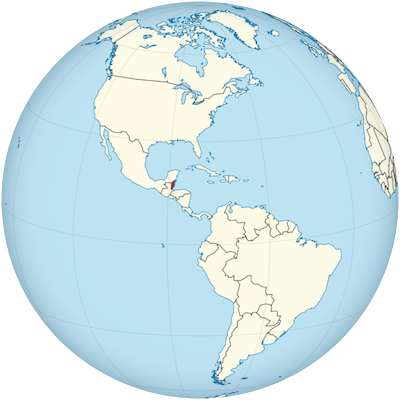

Belize (Image Source: Wikimedia Commons)

Belize (Image Source: Wikimedia Commons)


Textbook definitions of Latin America, include both a geographical and language component:

  1. Geography - Part of the Americas (including the Caribbean)

  2. Language - Speak the Romance languages (derived from Latin) that include Spanish, French, Italian, Portuguese, Catalan, Romanian and Occitan


However, some social scientists and many world organizations consider, Jamaica, Belize, and Guyana as part of Latin America, even though these 3 countries speak English and are all former British Colonies.

  • No definition of 'Latin America’ is accurate, without the inclusion of the complex struggles between conqueror and colonization.

What we call ‘Latin America’ today, is really nothing more than fragmented pieces of an indigenous ‘America,’ pieced together with ‘nation’ names. With this more complete definition, it’s easy to see why some geographers include these countries into the geographical area known as Latin America.

Bottom line

There are many views as to the origin of “Latin America” but one thing has always been clear. Latin America is a general term for speakers and inhabitants of the romance language-speaking regions in parts of North America and most of South America.

These people shared historical experiences of conquest by the Portuguese and Spaniards between the 15th and 18th centuries. They also shared a historic struggle to independence, and as we’ve seen, were brought together under this banner (of freedom and promotion of democracy) by their increasing concerns against U.S expansionist policies and domination. Latin America, as a racial concept exists due to the early U.S threat and the idea that the world’s main Latin power, France, would help curb this threat.


Valentina - mini.jpeg

Valentina is a guide for Pedal Chile and is our resident badass. Valentina was born and raised in La Patagonia, which probably explains her affinity for adventuring. When Valentina isn’t crushing some poor dude’s soul, you can find her shredding down Rucapillán. Favorite season: Austral Summer



Sources for this article:

  1. Bodenheimer, Rebecca. “What Is Latin America? Definition and List of Countries.” ThoughtCo, 28 July 2019, www.thoughtco.com/what-is-latin-america-4691831.

  2. Bulmer-Thomas, Victor. The Economic History of Latin America since Independence. Cambridge Cambridge Univ. Press, 2003.‌

  3. Eakin, Marshall C. A History of Latin America : Collision of Cultures. Basingstoke, Palgrave Macmillan, 2007.

  4. Gobat, Michel. “The Invention of Latin America: A Transnational History of Anti-Imperialism, Democracy, and Race.” The American Historical Review, vol. 118, no. 5, 25 Nov. 2013, pp. 1345–1375.

  5. Merriam-Webster. (n.d.). Latin America. In Merriam-Webster.com dictionary. From https://www.merriam-webster.com/dictionary/Latin%20America

  6. Webster, Edward, and Israel Webster. “William Walker.” Smithsonian Institution, 1857.

  7. Wikipedia Contributors. “Latin America.” Wikipedia, Wikimedia Foundation, 8 Mar. 2019, en.wikipedia.org/wiki/Latin_America.

Do You Think Differently in Different Languages?

thinkingandlanguages.jpg

Does language shape thought and, is our thought changed when we speak a different language?

The answer to this question is complicated. However, the short answer is kinda..but not by much. Language is more involved than just thought and communication. Culture, traditions, lifestyle, habits, family, and society all shape the way we think and talk.

Even though thousands of studies have been conducted and entire books written on this one seemingly simple question, it’s still hotly debated. However, the majority view among serious scholars, linguistics, psychologists, and anthropologists is that thought is NOT dependent on language as language is primarily an instinct and is coded into our DNA. 

What about for people that are actually bilingual and multilingual?…For these polyglots, the answer is still a bit muddled.....but possibly more so, compared to their monolingual peers.

The linguistic relativity hypothesis

The Selk'nam of Tierra del Fuego in Patagonia spoke a Chon language.

The Selk'nam of Tierra del Fuego in Patagonia spoke a Chon language.

The Sapir–Whorf hypothesis, also known as the linguistic relativity hypothesis, asks the question of whether speakers of different languages think differently.

This theory, which was developed in the 1920s and 1930s, proposes that our mother tongue determines the way we think and perceive the world.

Sapir and Whorf, the originators of this theory branded the theory as “linguistic relativity,” equating it to Einstein’s theory of relativity in terms of ‘importance to humanity.’

Is thought dependent on language?

The long-standing majority view on the Whorfian hypothesis is summarized in Steven Pinker’s 483-page bestseller, The Language Instinct. Pinker wrote:

Is thought dependent on language? Do people literally think in English, Cherokee, Kivunjo, or by 2050, Newspeak? Or are thoughts couched in some silent medium of the brain—a language of thought or“mentalese”—and merely clothed in words whenever we need to communicate them to a listener?
— The Language Instinct (page 56)

In response, Pinker wrote:

The famous Sapir-Whorf hypothesis of linguistic determinism, stating that people’s thoughts are determined by the categories made available by their language, and its weaker version, linguistic relativity, that differences among languages cause differences in the thoughts of their speakers ...is wrong, all wrong
— The Language Instinct (page 57)

But what about all those Eskimo words for snow?

The Linguistic Society of America (LSA) asks the same question, “Does the language I speak influence the way I think?” In this piece, the LSA gives the classic example of how the Eskimos have dozens or even hundreds of words for snow. The LSA says, “it's simply not true that Eskimos have an extraordinary number of words for snow.”

But what???

Eskimo -
A member of an indigenous people inhabiting northern Canada, Alaska, Greenland, and eastern Siberia, traditionally living by hunting (especially of seals) and by fishing.
— Oxford English Dictionary

The LSA goes on to refute this supposed Eskimo claim to fame of snowballing words through two primary reasons of logic:

1) What is an “Eskimo”?

Firstly, there isn’t one Eskimo language.

This archaic and possible offensive word, Eskimo, is generic labeling of hundreds of indigenous societies living throughout the northernmost latitudes of Canada, Alaska, Greenland, and Siberia….an area that spans nearly 4,000 miles (6,400km).

Eskimos' speak a variety of languages in the Inuit and Yupik languages. Both of these languages are comprised of even more distinct languages, with each having their own unique dialect.

2) What counts as “a word”? - Roots, words, & independent terms

What counts as a word?

Lu (Pedal Chile Staff) speaks 3 languages. Native Spanish, Portuguese and English

Lu (Pedal Chile Staff) speaks 3 languages. Native Spanish, Portuguese and English

The LSA ponders this question during their analysis of the larger dilemma of language and thought. “In English, we can combine words to get compound forms like snowball and snowflake, and we can add what are called ‘inflectional' endings, to get snowed and snowing.”

The Inuit and Yupik languages both belong to the larger Eskimo-Aleut language family. These languages are agglutinative, which mean they construct complex words out of smaller units.

Too often the search for shorthand and simple-minded ways to talk about the complexities of language and culture results in excessive reliance on inadequacy detailed illustrations. In the case of the snow example, sheer repetition reinforces it, embedding it ever more firmly in folk wisdom where it is nearly immune to challenge.
— Dr. Laura Martin

In English, we can make any number of sentences out of numerous combinations of words. Eskimo-Aleut languages do the same, except they build sentences into single words.

For example, in English, you could say “snow that is so deep you are riding to infinity on a cloud of snowy love.” This is 16 words and is called a sentence. In Inuit and Yupik, this would be a single word.

In English, if we wanted to describe snow as wet, we could say, wet snow, which is two separate words. In Eskimo-Aleut languages, instead of saying ‘wet snow’, they would say the equivalent of ‘wetsnow’, which, of course, is one word.

The Eskimo-Aleut language has an infinite number of possible words for snow……and for fish..music….and everything else.

If you only count the roots, English has a comparable number of ‘snow’ words, such as; sleet, slush, frost, blizzard, avalanche, drift, and flurry. That barely even scratches the snowy surface, since ski lingo has dozens more….powder, crud, crust, corduroy, and corn, just to highlight a few.

grammatical gender & thought

speakers of different languages tilt in different directions in a woolly task, rather than having differently structured minds’’
— Steven Pinker

Spanish, French, Italian, German, Russian, Polish, and Arabic are all examples of languages that use a gender system.

Grammatical gender languages assign all nouns to masculine, feminine, and/or neuter categories.

Guy Deutscher, an Israeli linguist and author of the book, Through the Language Glass: Why the World Looks Different in Other Languages, asks the question, “Can the grammatical gender of inanimate objects influence speakers’ associations?”

Dr. Deutscher contends that grammatical gender “does not restrict anyone’s capacity for reasoning” but instead “may come close to being a prison-house” of associations, and these “chains of associations” are “impossible to cast off.”

In, the ‘She-Land,’ Social Consequences of the Sexualized Construction of Landscape in North Patagonia by Paula Gabriela Nu ́n ̃ez, she says:

Penguins in Patagonia

Penguins in Patagonia

Patagonia was first described in Spanish, which introduces a subtle but important slant. The articles in Spanish grammar have gender; thereby the land is classified as feminine and is a ‘she-land’ directly projected in the ‘mother-land’ metaphor, usually associated with agrarian activities or cultures.

The concept of ‘Pachamama’ (‘Mother Land’ in Quechua) is a classical reference to the original people of the South American Andes. The ‘gendered’ articles not always have these projections. For example, even though ‘landscape’ is a masculine word in Spanish, the land has a stronger female character. This female character ties the non-urban landscape to a feminine consideration, because of its referral to the ‘land’ or ‘nature,’ another female word.

The Nations depicted Patagonia as a woman because it was incomplete, capricious and contained a small population. And as a woman, free to her initiatives and ideas, she was a danger to herself or to the countries
— Paula Gabriela Núñez

All nouns in Spanish have grammatical gender:

  • la = feminine form of “the”

  • el = masculine form of “the”

La Patagonia is feminine, and the masculine form would be El Patagonio, which to Spanish speakers just sounds weird.

Patagonia as a ‘she’ projects ‘mother/female’ qualities and is hard to dissociate those qualities from the place on a subconscious level for native Spanish speakers.

With that being said though, being “shackled” might not be so bad:

How tedious it would be if bees weren’t “she’s” and butterflies “he’s,” if one didn’t step from feminine pavements to masculine roads, if twelve masculine months didn’t crowd inside one feminine year, if one couldn’t greet Mr. Cucumber and Lady Cauliflower in the proper way. I would never want to forfeit my genders. Along with Aunt Augusta, I would rather say to the English language that to lose one gender may be regarded as a misfortune; to lose both looks like carelessness.
— Guy Deutscher from "Through the Language Glass"

Thinking differently in a second language

Noam Chomsky has famously argued that a Martian sci­entist would conclude that all earthlings speak dialects of the same language.
— Guy Deutscher in Through the Language Glass

When people ask the question, do you think differently in a different language, what they are really asking multilingual speakers is “do you think differently in your second language.”

Since the 1950s, thousands of studies have been conducted. However, the vast majority of research looks predominately at monolinguals.

Language and thought with regards to bilingualism have been largely untouched.

However, the paucity of research that does exist finds that bilinguals and multilingual speakers DO think differently in their second and third languages. But understanding what it means to “think differently in a different language” is a bit nuanced.

Let us go to an example to better illustrate.

Yanira (native Spanish and fluent English)

Yanira (native Spanish and fluent English)

There are a series of experiments conducted on more than 300 Koreans and U.S nationals that found that thinking in a second language reduces biases that ultimately affects how we perceive risks and benefits. Even though the aim of the research was different (to show where bias occurs or which language is most likely to spur rational decisions in the face of risks and benefits), it serves our purpose perfectly.

Most of us think that they would intuitively make the same choices regardless of whether they are using their first or second language and that the difficulty of using the second or third language would make their decisions a lot less systematic. According to this study, even when you are well fluent in the other language, our thinking would be different, and so would be our decisions.

As humans, our reasoning is shaped by two distinct modes of thought. One of them is quick, unconscious, and emotionally charged. The other is analytical, systematic, and highly cognition-intensive.

My friend Katherine who speaks both English and Spanish fluently

My friend Katherine who speaks both English and Spanish fluently

It’s possible that communicating in a learned language would force you to make different decisions from the ones you’d ordinarily make in your first language, which, according to the study in question, would be more deliberate. This is because the role of an unreliable instinct is reduced in the second language. According to research, immediate emotional responses to emotively charged phrases are hushed in non-native languages.

But does this really mean that one is actually thinking any differently or just “getting inside their head” even more so than they already are?

Dr. Aneta Pavlenko, Ukrainian-American linguist, and author of the book, The Bilingual Mind and What It Tells Us About Language and Thought. Is one of the foremost experts on the relationships between bilingualism, cognition, and emotion.

Dr. Pavlenko in numerous articles and books says that you don’t actually think any differently in your second language as your first. What happens, she says, is bilinguals apply the principles of their first language to their second and third languages. While it’s possible to understand the norms of a second language, integrating these linguist differences requires conscious thought. The ability to seamlessly toggle from one language to another happens every day, all over the world, but underneath the second language (L2), the L1 (first language) is always operating.

final thought

While language does not necessarily determine thoughts, and while thinking may be possible without the aid of language, the languages that we speak can have an impact on our overall perspective of our reality. But by how much? About this much (————), más o menos.

My good friend Yanira, who speaks native Spanish and fluent English (L2) says it best, “I’m Yanira in Spanish and I’m Yanira in English.”


jesse blog picture.jpg

Jesse is the Director for Pedal Chile and lives in La Patagonia (most of the year). Jesse has a Master of Science in Health and Human Performance and is an avid mountain biker. Hobbies: Reading, writing, researching, and learning.


Sources for Do You Think Differently in a Different Language:

  1. Ayçiçegˇi, Ayşe, and Catherine Harris. “BRIEF REPORT Bilinguals’ Recall and Recognition of Emotion Words.” Cognition and Emotion, vol. 18, no. 7, Nov. 2004, pp. 977–987.

  2. Casasanto, Daniel. “Who’s Afraid of the Big Bad Whorf? Crosslinguistic Differences in Temporal Language and Thought.” Language Learning, vol. 58, Dec. 2008, pp. 63–79‌.

  3. Dewaele, Jean-Marc, and Seiji Nakano. “Multilinguals’ Perceptions of Feeling Different When Switching Languages.” Journal of Multilingual and Multicultural Development, vol. 34, no. 2.

  4. Deutscher, Guy. Through the Language Glass : How Words Colour Your World. London, Arrow, 2011.

  5. “Does the Language I Speak Influence the Way I Think?  “Linguistic Society of America.” Linguisticsociety.Org, 2012.

  6. Keysar, B., Hayakawa, S. L., & An, S. G. (2012). The Foreign-Language Effect: Thinking in a Foreign Tongue Reduces Decision Biases. Psychological Science, 23(6), 661–668. https://doi.org/10.1177/0956797611432178

  7. Kroll. Judith F, and A  M  B  De Groot. Handbook of Bilingualism : Psycholinguistic Approaches. Oxford ; New York, Oxford University Press, 2009.

  8. ‌Martin, L., 1986. "Eskimo Words for Snow": A Case Study in the Genesis and Decay of an Anthropological Example. American Anthropologist, 88(2), pp.418-423.

  9. Núñez, Paula Gabriela. “The ‘She-Land,’ Social Consequences of the Sexualized Construction of Landscape in North Patagonia.” Gender, Place & Culture, vol. 22, no. 10, 9 Jan. 2015, pp. 1445–1462.

  10. Pavlenko, Aneta, and Cambridge University Press. The Bilingual Mind : And What It Tells Us about Language and Thought. Cambridge, Cambridge University Press, Druk, 2019.

  11. Pavlenko, Aneta. “What Does It Mean to Think in a Second Language?” Psychology Today, 10 Mar. 2015.

  12. Stam, Gale. Digital Commons@NLU. “Can an L2 Speaker’ s Patterns of Thinking for Speaking Change?” 2010.

How Often Should You Wash Mountain Bike

Just doing a quick wash after a ride

Just doing a quick wash after a ride


How often should I wash my mountain bike?

Ideally, you should do a quick clean and re-lube after every hard ride or two. A more in-depth wash is necessary if you ride through rain or mud.

  • Keeping your MTB clean (particularly drivetrain) is the most important preventative maintenance you can perform for your mountain bike.


  1. Clean your mountain bike (after every hard ride or two)

    • Dry it off (thoroughly)

    • Then lubricate the chain (properly)

  2. If you don’t want to wash your bike that frequently, at least clean your chain after every ride.

    • 1) Grasp your chain with a rag

    • 2) Turn the crank backward for at least 30 seconds

    • 3) Lubricate chain

    • 4) With clean rag repeat steps 1 & 2 to get off excess lube

A more in-depth cleaning is needed after riding through river crossings

A more in-depth cleaning is needed after riding through river crossings

The Importance of a clean mountain bike

The best thing you can do to lengthen the life of your drivetrain is to keep it clean. Nothing wears out parts faster on a bike than dirt. Dirt and road grime gets in between the chain and sprockets and grinds away at both in a vicious circle. Taking the time to clean your bike not only prolongs its life, but also makes your bike shift better and quieter.
— Christopher Wiggins from the book "Bike Repair & Maintenance"
 

Routine washing of your bike will significantly prolong ALL the components. Especially, the parts of your drivetrain, such as:

  • Cogs

  • Chainring

  • Chain

  • Derailleur(s)

Since your drivetrain is exposed to all the elements, it needs frequent cleanings.

How to do a quick mtb wash

There are many different philosophies on this seemingly simple task. Below I have outlined a quick cleaning routine that takes less than 10 minutes and doesn’t require a bike repair-stand. Also, if you clean your drivetrain regularly, you can mostly avoid having to use solvents.

1) Hose your bike down

Hosing bike down after a ride

Hosing bike down after a ride

If you clean your bike regularly, all you need is:

  • Soap

  • Water

  • Sponges

  • Brushes

Wet your bicycle with the hose, then work with the brush from the top down using plenty of soapy water. Rinse the soap off and wipe it down
— Trek Bikes Owner's Manual
  1. Step one: Hose your bike down

    • It’s super important to AVOID using high-pressure washers, such as you find at the car wash or other industrial sprayers

    •  If you use a high pressure nozzle, do not point it at the bike from the side as it can blow the bearing seals inward

      • High-pressure washes can push water past seals in your hubs, bottom bracket (BB), pivot/shock seals, and headset

For a quick wash, you can leave the wheels on. Also, if you don’t have a hose, you can use a water bottle.


super fast lube.jpg

2) Scrub entire bike & wheels with hot, soapy water

Scrub a dub-dub

Scrub a dub-dub

  1. Wash with a big sponge for gentle frame cleaning and easy to reach places

  2. Use a stiff nylon-bristle brush for tough and hard to reach places

  3. Leave the chain, cogs, chainrings, and derailleurs for last and use a separate brush

  4. Don’t forget to wash the tires

  5. Can clean disc rotors with rubbing alcohol

With this quick wash, I don’t recommend using a degreaser. If you wash your bike frequently, a degreaser is not necessary and can lead to “over-cleaning” your drivetrain.

3) Rinse your Mountain bike

Jet washers have certainly sped up the process, but they are noisy and wasteful and eventually break down. Pro teams use them for speed, but amateurs shouldn’t
— Guy Andrews & Rohan Dubash in "Bike Mechanic"

You can hose off your bike or wipe it down with a wet rag. Just remember not to use too powerful of a sprayer.

Once again, avoid getting water into the bearings of the bottom bracket, headset, or hubs.

What if I don’t have a hose?

You can fill up a water bottle and spray onto the bike, working from the top downwards. The soap and scrubbing are what loosens the dirt, and a light rinse will remove the rest of the grime, and soapy residue.


Basically, a gentle rain
— C. Calvin Jones of ParkTool talking about rinsing a bike

4) Dry off the bike

Using leaf blower to blow my bike dry

Using leaf blower to blow my bike dry

You can use an air compressor, leaf blower, or towel. 

If not, drop your mountain bike a few times from a couple of feet as this will knock off excess water.

Also, wrap a clean towel around the chain and spin the crank in reverse for at least 15 seconds. This will dry the chain, which you want before applying lubricant.

5) Apply lube to the chain

Anytime you clean your mountain bike, you must apply lube to the chain, as the washing process will remove some of the lube.

It is not necessary to have a heavy coating of lubricant on the outside of the chain or on the teeth of your chainrings and cogs. Rather, it’s the inner surfaces of the chain where wear takes place - the interfaces of the pins, plates, and rollers.
— Todd Downs in "The Bicycling Guide to Complete Bicycle Maintenance"
 
Wiping off excess chain lube

Wiping off excess chain lube

The largest factor causing a dirty drivetrain is too much lubricant. Excess lube on the outside of the chain will transfer to the cogs and chainring, which makes them “dirt magnets.”

After you have lubed your chain, make sure to spend at least 15 seconds wiping off the excess lubricant. You can’t wipe the chain off “too much,” so wipe it down well.

Final Thought

 
There’s a difference between maintenance and repair. You know the saying, an ounce of prevention is worth a pound of cure? Well, maintenance is prevention and repair is that costly cure.
— Jenni Gwiazdowsk in "How to Build a Bike"


The easiest and best preventative maintenance you can perform is simply to wash your bike or at the very minimum, your chain. Frequent and routine bike cleaning is easy. This will extend the life of your bike, as well as keep your bicycle running like new.

However, as one of my riding buddies likes to say, “it’s a tool, not a jewel.”


jesse blog picture.jpg

Jesse is Director of Pedal Chile and lives in Valdivia, Chile (most of the year). Jesse has a Master of Science in Health & Human Performance and is an avid MTBer, snowboarder, reader of narrative non-fiction, & frequent cleaner and luber of his bikes.


More articles from PEDAL CHILE

Sources:

  1. Downs, Todd. The Bicycling Guide to Complete Bicycle Maintenance & Repair for Road & Mountain Bikes. Emmaus, Pa., Rodale, 2010.

  2. Gwiazdowski, Jenni. How to Build a Bike : A Simple Guide to Making Your Own Ride. London, Frances Lincoln Limited Publishers, 2017.

  3. Park Tool, and C. Jones. “How to Wash a Bike.” YouTube, 27 Oct. 2015.

  4. Rohan Dubash, and Guy Andrews. Bike Mechanic : Tales from the Road and the Workshop. London, Bloomsbury, 2014.

  5. Trek Bicycle CorporationHOW TO HAVE MORE FUN ON YOUR NEW BIKE. 2018.

  6. Wiggins, Christopher. Bike Repair & Maintenance. New York, New York, Usa, Alpha, A Member Of The Penguin Group (Usa) Inc, 2014.

  7. Zinn, Lennard, and Todd Telander. Zinn & the Art of Mountain Bike Maintenance : The World’s Best-Selling Guide to Mountain Bike Repair. Boulder, Colorado, Velopress, 2018.

What Country Has Most Active Volcanoes

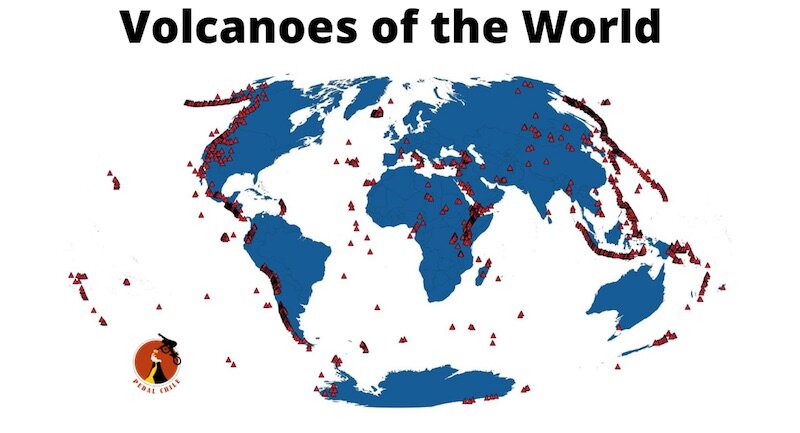
Volcanoes of the World.jpg

Volcanic activity is the reason why the famous Big Island of Hawaii got 1 ½ kilometers of a fresh coastline not so long ago, why Guatemala’s El Rodeo cannot support human life anymore and why airports in different parts of the world, such as Bali in Indonesia have been getting closed unprecedentedly.


Our planet has 1,500 potentially active volcanoes, excluding the volcanoes on the ocean floor at spreading centers such as the Mid-Atlantic Ridge, a huge mountain range at the bottom of the Atlantic Ocean.

Yes, there could be more volcanoes in the ocean than on the earth’s surface, with experts estimating them to be about 10,000!


There are countries that rank extremely high in the number of volcanoes present within their borders worldwide and others in the total number of active volcanoes, and this article is here to clear the air for you in that regard with facts, as we explore some of the fiercest places on earth.

Let’s start with the top 7 most volcanic places on EARTH!

The most volcanic places on earth

1.    Indonesia

Semeru, Indonesia

Semeru, Indonesia

Approximately 13% of the world’s active volcanoes are located in Indonesia
— Akhmad Zaennudin

Indonesia contains so many active volcanoes that experts assert that more than 197 million Indonesians are living within 100 km of a volcano, with 9 million of them being within just 10 kilometers. 

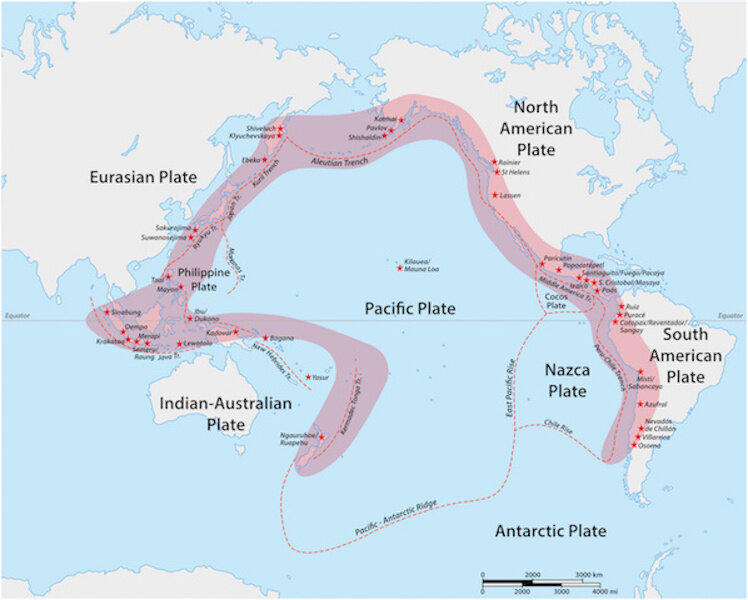
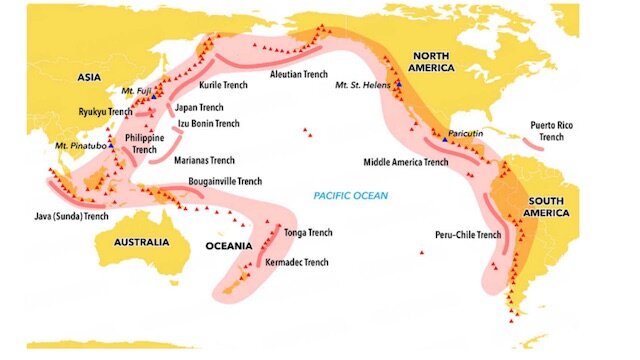
Indonesia has the highest number of active volcanoes in the world and is one of the places in the world that are located within the Pacific Ring of Fire. This is a 25,000 mile (40,000km) horseshoe-shaped region that borders the Pacific Ocean, where countless tectonic plates clash.

Indonesia has 147 volcanoes, 129 of which are active. They spread along the islands of Sumatra, Celebes, Java, Bali, Nusa Tenggara, Maluku, Lesser Sunda, and Sulawesi islands.

Why does Indonesia have so many volcanoes?

Tectonically, the active volcanoes are the result of a collision between 3 primary tectonic plates:

  • The Eurasian Plate moving south

  • The Indian-Australian plate moving north

  • Philippine Plate moving west

plates of the pacific ring of fire.jpeg

2.    Chile

Chile is home to over 2,000 volcanoes, 60 of which have erupted over the last 450 years, and according to the Global Volcanism Program, has 122 active volcanoes.

Villarrica volcano, one of the most active volcanoes, with 59 episodes eruptions since 1558

Villarrica volcano, one of the most active volcanoes, with 59 episodes eruptions since 1558

According to experts, about 40 could start erupting in the future. Chile has the second most active string of volcanoes, only surpassed by Indonesia.

In this country, we find Llaima and Villarica, two of the most active volcanoes in Latin America.

The country is found between the Nazca (an oceanic tectonic plate located in the eastern Pacific Ocean basin) and South American Tectonic Plates. The plates shift slowly due to a river of hot magma. The plates either move away from each other or hit against each other, and this underground movement causes volcanoes.

The most recent volcanic eruption in Chile occurred near Puerto Montt, in April 2015 where the Calbuco Volcano exploded and spewed a huge volume of ash that spread to Argentina. The eruption occurred in three phases and debris from the activity landed and piled up to a depth of 2 feet in some areas and thousands of people were evacuated from the area. This is the first time the volcano erupted in four decades.

Where is the world’s highest active volcano?

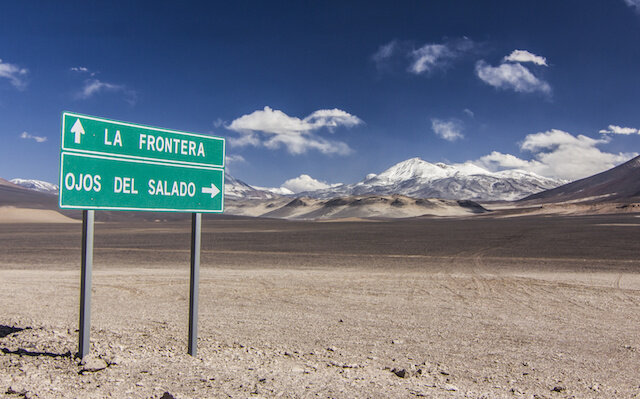
  • Ojos del Salado on the Chilean and Argentinian border is the highest active volcano in the world at 22,614 feet (6,893 m), which is also Chile’s highest peak.

ojos del salado volcano in chile .jpeg

3. Japan

The tallest mountain in Japan is called Mount Fujiyama, which is an “active” volcano more famously known as Mount Fuji, which last erupted in 1707.

Japan alone accounts for nearly 1/10 of all the world’s active volcanoes with 108 of them currently active, more than any country except Indonesia and Chile.

Japan’s Mt. Fuji

Japan’s Mt. Fuji

These volcanoes belong to the Pacific Ring of Fire, a chain of volcanoes found throughout the Pacific Ocean and one of the most geologically active regions on our planet. 

The Ring of Fire extends from New Zealand clockwise in an almost circlular arc through: 

  • Indonesia 

  • Philippines

  • Japan

  • Papua New Guinea

  • Kamchatka Peninsula of Russia

  • Aleutian Island of Alaska (USA)

  • Western coasts of North, Central, and South America 

  • Also, the interior includes the Galapagos Islands and the Hawaiian Islands

The “Ring of Fire” (Image Source: Pambudi)

The “Ring of Fire” (Image Source: Pambudi)

4. Papua New Guinea

Papua New Guinea is in orange. The western half of the Island is part of Indonesia (blue)

Papua New Guinea is in orange. The western half of the Island is part of Indonesia (blue)

This island nation has nearly as many active volcanoes as Japan.

Papua New Guinea (PNG) is slightly larger than the state of California, except here, you will find 94 active volcanoes, including a “Decade Volcano.” 

Just Like Indonesia and Japan, Papua New Guinea falls in the Pacific Ring of Fire. Which makes sense as PNG shares an island with Indonesia. 

So what is a Decade Volcano? 

The International Association of Volcanology and Chemistry of the Earth’s Interior has identified 16 volcanoes for intensive research because of their history of explosive eruptions in the proximity of populated areas. 

They are named “Decade Volcanoes” because the project was created in the 1990s by the United Nations to bring awareness to natural disasters.

5. Ethiopia

Volcanologist, David Pyle says, “the Ethiopian rift hosts nearly 60 volcanoes that are thought to have erupted in the past 10,000 years.” Making Ethiopia the 5th most geologically active country in the world.

Erta Ale - Maybe the most famous volcano in Ethiopia

Erta Ale - Maybe the most famous volcano in Ethiopia


Of all the volcanoes on Earth, only 7 have an active lava lake. Erta Ale in Ethiopia actually has two lava lakes, one of which has been active for over a century.

6. Philippines

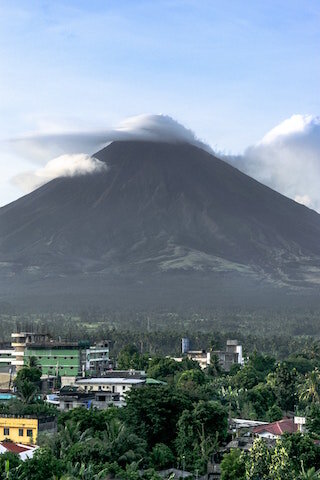
Volcano Mayon in Albay is the most active volcano in the Philippines

Volcano Mayon in Albay is the most active volcano in the Philippines

The Philippines have a total of 53 active volcanoes and the country is graced by such a huge number owing to its location in the Pacific Ring of Fire.

The volcanoes in this country are sometimes ranked as not only the most deadly, but also the most costly in the world.

Statistically, its historic eruptions that include the Mayon and Taal volcanoes have led to serious fatalities, and as high as 22% of its eruptions have caused substantial damage to the country.

The Philippines also witnesses lahars or mudflows and tsunamis that accompany eruptions more frequently than any other part of the world.

The most recent volcanic activity in the country was in January 2020, when a towering column of a 9-mile tall cloud of ash was seen spewing from the Taal volcano, which spread as far as 40 miles away and into the capital, Manila.

The eruption triggered a huge lightning and 144 earthquakes. More than 450,000 people were evacuated from the area.

7.    Guatemala

Volcan Fuego, Antigua, Guatemala

Volcan Fuego, Antigua, Guatemala

Just like Indonesia, Guatemala’s location within the Ring of fire is responsible for the threatening array of volcanoes found there. In this region, some experts call this the Central American Volcanic Arc (CAVA), which runs through five Central American countries, most notable Guatemala (El Salvador, Honduras, Nicaragua, and Costa Rica).

The country has 37 or more volcanoes, including the famous Fuego, Santiaguito, and Pacaya. The most recent eruption in the country was in June 2018, when the Fuego volcano near Guatemala City erupted, affecting more than 1.7 million people in three central states and killing hundreds as its deadly lava flows and clouds of ashes submerged entire villages.

How is an “active volcano” defined?

According to the Global Volcanism Program, an active volcano is one “that has erupted since the last ice age (i.e., in the past ~ 10,000 years).

By this definition, planet Earth has approximately 1,500 active volcanoes. On average, about 60 volcanoes erupt globally per year.

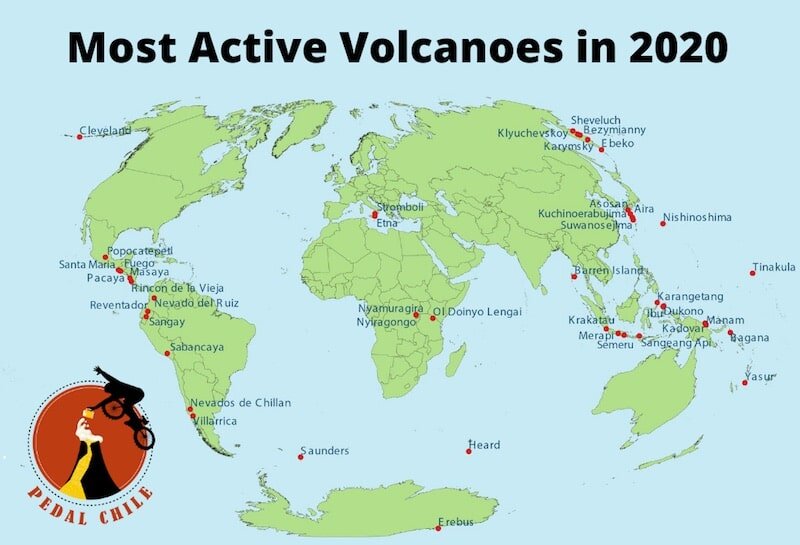
This map shows the most active volcanoes of recently….which means these volcanoes have actually erupted within the last decade

This map shows the most active volcanoes of recently….which means these volcanoes have actually erupted within the last decade

Countries with the most dormant & extinct volcanoes

About 60 of the Earth’s 550 historically-active volcanoes are in eruption each year
— This Dynamic Planet World Map of Volcanoes, Earthquakes, Impact Craters, and Plate Tectonics

What is a “dormant” and “extinct” volcano?

  • A dormant volcano is a volcano that hasn’t erupted in the past 10,000 years, but is expected to erupt again.

  • An extinct volcano is a volcano that is never expected to erupt again, but it’s probably safe to never say never.

#1. Chile

Chile is home to 2085 volcanoes, 94% of which are dormant or extinct.

The Chilean Southern Volcanic Zone (SVZ) stretches from near Santiago southwards to Cerro Hudson, in central Patagonia. This region is volcanologically the most active region of the Andes Mountain.

Why does Chile have so many volcanoes?

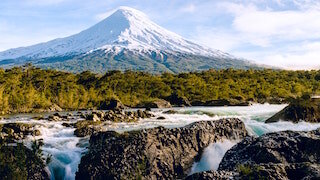
Volcan Osorno, Chile (glacier-covered stratovolcano)

Volcan Osorno, Chile (glacier-covered stratovolcano)

Chile, like most volcanic regions, is located at the convergent boundary between a continental plate and an oceanic plate. When these plates converge, the heavier oceanic plates dives (subducts), below the lighter continental plate.

The result is molten rock (magma) from the pressure and heat and is called a subduction volcano.

2. Russia

Russia has over 400 volcanoes, most of which are found in the Kamchatka Peninsula on the eastern side of the country. Here, according to NASA, there are over 300 volcanoes, 29 of which are active. 

Kamchatka Peninsula

Kamchatka Peninsula

The highest volcanic mountain in Russia is known as Klyuchevskaya Sopka and stands at 15,584 feet (4,750 meters) above sea level. It’s also the biggest active volcano in the Northern Hemisphere. 

In January of 2011, the Kamchatka Peninsula had four volcanoes erupting simultaneously, all within 110 miles (180km) of each other.

3. Japan

Mount Fuji is the tallest volcano in the country

Japan has the third most volcanoes on Earth, totaling 270.

The volcanoes are part of the Pacific Ring of Fire and most of these volcanoes are found in Hokkaido, Chubu, Kanto, and Tohoku regions.

4. The United States of America

The U.S. has the 4th most volcanoes on Earth, 262 in total. Most of these volcanoes are found in Alaska, where you’d find eruptions nearly every year. The other volcanoes are located along the Pacific Ocean, and Hawaii, which houses Kilauea, the most active volcano on the planet. This volcano has continuously erupted since 1983.

Mount Hood is a stratovolcano in Oregon, United States of America

Mount Hood is a stratovolcano in Oregon, United States of America

How many volcanoes are in Alaska?

  • 91

  • This means that 35% of all volcanoes in the United States can be found in Alaska

What state has the second most?

  • California and Oregon tie….with 17 each. Mount Shasta and Mount Hood might be the most famous in each state.

5. Indonesia

A master of volcanoes it seems, Indonesia also makes it to this list by having a total of 147 volcanoes. It is said that the largest eruptions on earth so far have occurred in Indonesia.


Bottom line

It’s clear that scientists are only starting to scratch the surface when it comes to the discovery of the existing number of volcanic mountains and active volcanoes in the planet. This is especially because 80 percent of the volcanic eruptions occur in the ocean, an area that is largely under-researched.


chain lube graphic.png

Valentina - mini.jpeg

Valentina is a guide for Pedal Chile and is our geology expert. Valentina has been in love with volcanoes ever since she first saw Villarrica glowing in her native country of Chile. Valentina was born and raised in La Patagonia, which probably explains her affinity for adventuring. When Valentina isn’t crushing some poor dude’s soul, you can find her shredding down Rucapillán. Favorite season: Austral Summer

More articles from Pedal Chile


References

  1. “Calbuco Volcano Erupts.” Nasa.Gov, NASA Earth Observatory, 24 Apr. 2015, earthobservatory.nasa.gov/images/85767/calbuco-volcano-erupts.

  2. Cermak, Jan. Illustrated History Of Natural Disasters. 2016.‌

  3. Charles Arthur Wood, and Jürgen Kienle. Volcanoes of North America : United States and Canada. New York, Cambridge University Press, 1990.

  4. Dzierma, Yvonne, and Heidi Wehrmann. “On the Likelihood of Future Eruptions in the Chilean Southern Volcanic Zone: Interpreting the Past Century’s Eruption Record Based on Statistical Analyses.” Andean Geology, vol. 39, no. 3, 27 Sept. 2012.

  5. “Four Erupting Volcanoes on the Kamchatka Peninsula.” Earthobservatory.Nasa.Gov, 3 Feb. 2013.

  6. Global Volcanism Program, 2013. Volcanoes of the World, v. 4.9.0 (04 Jun 2020). Venzke, E (ed.). Smithsonian Institution

  7. “Hudson.” Www.Volcanodiscovery.Com, www.volcanodiscovery.com/hudson.html.

  8. Irfan, Umair. “A Volcano in the Philippines Is Spewing Ash and Threatening a Bigger Eruption.” Vox, 13 Jan. 2020.

  9. Lara, Luis E. “The 2008 Eruption of the Chaitén Volcano, Chile: A Preliminary Report.” Andean Geology, vol. 36, no. 1, Jan. 2009.

  10. Oppenheimer, C., et al. “Sulfur, Heat, and Magma Budget of Erta ‘Ale Lava Lake, Ethiopia.” Geology, vol. 32, no. 6, 2004, p. 509.

  11. Pambudi, Nugroho Agung. “Geothermal Power Generation in Indonesia, a Country within the Ring of Fire: Current Status, Future Development and Policy.” Renewable and Sustainable Energy Reviews, vol. 81, Jan. 2018, pp. 2893–2901.

  12. Porterfield, Jason, and Corona Brezina. Chile : A Primary Source Cultural Guide. New York, Rosen Publishing Group’s, 2004‌.

  13. Pyle, David. “Volcanoes of the Ethiopian Rift Valley | Www.Oxfordsparks.Ox.Ac.Uk.” Www.Oxfordsparks.Ox.Ac.Uk, 17 Nov. 2015.

  14. Simkin, Tom, et al. This Dynamic Planet World Map of Volcanoes, Earthquakes, Impact Craters, and Plate Tectonics. 1994.

  15. “Volcanoes of Indonesia.” Volcanodiscovery.Com, 2020, www.volcanodiscovery.com/indonesia.html.

  16. ‌“Volcanoes of Japan: Facts & Information / VolcanoDiscovery.” Volcanodiscovery.Com, 2020, www.volcanodiscovery.com/japan.html.

  17. “Volcanoes of Kamchatka.” Nasa.Gov, NASA Earth Observatory, 25 Sept. 2014, earthobservatory.nasa.gov/images/84427/volcanoes-of-kamchatka.

  18. Why Guatemala’s Volcano Has Been More Deadly Than Hawaii’s.” The New York Times, 8 June 2018, www.nytimes.com/2018/06/08/science/volcano-guatemala-hawaii.html.

  19. Zaennudin, A.: “The characteristic of eruption of Indonesian activevolcanoes in the last four decades,” J. Lingkungan dan BencanaGeol., 1, 113–129, 201.

Snowiest cities in the Southern Hemisphere

Yes….it snows in Southern Chile….also known as “The Patagonia”

Yes….it snows in Southern Chile….also known as “The Patagonia”


Top 5 Snowiest Towns/Cities in the Southern Hemisphere

Most people that consider themselves weather-minded are often familiar with Vostok, Antarctica, and Death Valley, California, due to the extreme temperature ranges recorded in these areas. However, when you include “the snowiest areas” in the query, and limit the scope to the Southern Hemisphere, you get all sorts of “uncertain” responses.

Determining the snowiest areas in this region is difficult, owing to its geography. It has a smaller landmass and an abundance of water south of 40 degrees that limit zones of cold and snow to higher mountain elevations and Antarctica.

But as you are going to find out, there are known and hidden towns in the Southern Hemisphere that are very snowy, and this article brings to you the top five!

#1. Villa Las Estrellas, Antarctica

Besides having heavy snow, coupled with strong, continuous winds, Villa Las Estrellas has a yearly temperature mean of 28°F (-2°C), making it warmer than the Antarctic mainland.

The temperatures can, however, go as low as -52°F (-47°C) during winter, when the entire place is always buried by meters of snow, making it a little challenging for an average person to make it past the first week.


Villa Las Estrellas is one of the two towns in Antarctica that are regarded as civilian towns, the other one being the Argentinian Esperanza base that houses 55 winter residents.

As you’d expect, its harsh conditions that include deep snow are the reason you’d hear people saying that Villa Las Estrellas could be the closest we can get (here on earth) to experiencing life on an alien planet.

This town at the bottom of the planet was founded in 1984 when Chile was looking to strengthen its territorial claims in Antarctica. It is usually home to a range of between 200 to 7,000 people (depending on the season) and is often described as one of the safest places on earth (from human aggression, of course).


Villa Las Estrellas means “The Stars Village” in English


Base Presidente Eduardo Frei Montalva in Chile’s Antarctica - 800 meters away from Villa Las Estrellas (Image Source)

Base Presidente Eduardo Frei Montalva in Chile’s Antarctica - 800 meters away from Villa Las Estrellas (Image Source)


#2. Bariloche, Argentina

Also known as the King of Argentinian winters, Bariloche is often the tourist destination for northern and southern hemisphere tourists looking for their “never-ending winter” pristine powder fix.


Ski resort in Bariloche

Ski resort in Bariloche


Its temperatures can go as low as 2°F (-16°C) and heavy snowfall has been recorded countless times, with the most recent (in 2019) depth of 4 feet recorded in Cerro Catedral Ski Resort in Bariloche.

The town experiences varying climatic ranges owing to its high elevation in the mountains, with temperatures dropping severely during the night, something that accounts for a huge discrepancy between low and high daily temperatures. Snow tends to appear on the mountain peaks during summer, and the winters are as long as they are cold, precisely why there’s a skiing culture predominant in the town.

#3 & #4. Wanaka & Queenstown, New Zealand

These two towns not only have (almost) similar weather conditions, they also are neighbors in the South Island of New Zealand.

For years, these have been some of the snowiest places in the Southern Hemisphere, and it is here where you are likely to see snow on the mountains on some days and endless snowfalls going on in the other areas for days, leading to major road shutdowns.


Queenstown, New Zealand

Queenstown, New Zealand


This is often the case in July, during winter when there is recurrent freeze and melt see-saws (as snowfalls are often followed by temperature rises).

Due to the high extent of snowfalls in these towns, there are five commercial ski resorts here, which include The Remarkables, Cardrona, Coronet Peak, Snow Farm, and Treble Cone.

As part of the Southern Island’s snowy climate, these areas receive precarious snowfalls that can go up to 21 inches (53 cm), creating extremely, thick and dense veils of snow everywhere.


Lake Wanaka, New Zealand

Lake Wanaka, New Zealand


#5. Oberon, Australia

It’s worth noting that due to its separation from the Polar Regions by the Antarctic Ocean, Australia is not subjected to the frigid polar air that sweeps over the Northern Hemisphere. That makes it unlikely to have areas that receive heavy snow.

However, there is a small town known as Oberon that breaks the odds.

The town sits on the Blue Mountains at an altitude of 3,650 feet (1113 meters) above sea level and is one of the few areas in the Southern Hemisphere that are most famous for snow. When the first snowflakes start falling each year, visitors from Australia and beyond begin popping up on almost every street, in preparation for snowball fights and cuddling up by open fires when the weather becomes bearable.

Here, snow can fall at any time of the year in the town but it is often thicker during the winter months. Usually, you’ll find up to four good snowfalls in the season, with one snowfall seeing snow lying around for 24 hours or more. A heavy fall on the other hand usually leaves the snow around for a few days or up to one week.

The depth of snow in Oberon can go up to 8 inches (20 cm) and temperatures up to 21°F (-6°C). This scenic town has all the key factors that make it a huge magnet for snow (including elevation, conditions that favor precipitation and cold temperature), making it a snow gem in the middle of the Blue Mountains.

Mount Buller, Australia - about 491 miles from Oberon

Mount Buller, Australia - about 491 miles from Oberon

Bottom line

The Southern Hemisphere doesn’t get much snow throughout the year, and generally, its winters are mild (compared to the Northern Hemisphere). This is the region where you’ll find countries or cities experiencing snow once every decade or century, while others lacking any documented evidence of ever experiencing any real snow in history.

The First Olympic Winter Game took place in 1924 in Chamonix, France. Of the 22 subsequent Winter Olympics, none have been held in the Southern Hemisphere…and it makes sense.

But as we’ve seen, there are a couple of towns that can brag about a decent amount (or extreme, in some cases) of snow each year within the Southern Hemisphere. Admittedly, they were difficult to find, but the results were inspiring.


Valentina - mini.jpeg

Valentina is a guide for Pedal Chile and is our resident badass. Valentina was born and raised in La Patagonia, which probably explains her affinity for adventuring. When Valentina isn’t crushing some poor dude’s soul, you can find her shredding down Rucapillán. Favorite season: Austral Summer


More articles from Pedal Chile

References:

  1. CNN, By Cathy Brown. “The Best Things to Do in Bariloche, Argentina.” 

  2. ‌Crowe, Alex. “It’s Snow Beautiful! Region Laps up Weekend White-Out.” Central Western Daily, 10 Aug. 2019, www.centralwesterndaily.com.au/story/6321006/its-snow-beautiful-region-laps-up-weekend-white-out/.

  3. ‌Moon, Linda. "Does It Snow in the Blue Mountains.” 11 July 2012,

  4. ‌O’Reilly, Jessica, and Juan Francisco Salazar. “Inhabiting the Antarctic.” The Polar Journal, vol. 7, no. 1, 2 Jan. 2017, pp. 9–25.

  5. ‌Richard Fisher. The Icy Village Where You Must Remove Your Appendix. www.bbc.com/future/gallery/20180810-villas-las-estrellas-antarctica-base-residents-surgery.

What is Seat Tube Angle?

seat-tube-angle.jpg

What is seat tube angle?

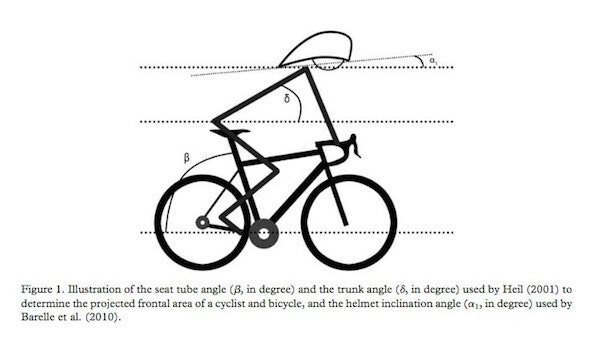
Traditionally, seat tube angle (STA) is defined as the angle between the seat tube and a horizontal line running through the bottom bracket.


In simpler terms, this translates to the angle between the seat tube and the ground (See Figure 1).

  • This affects the center of gravity and the distribution of weight on the wheels.

  • Steeper STA improves pedaling efficiency but makes steering more difficult and worsens stability as weight is shifted to the front of the bike (example: Triathlon Bike).

  • A slacker STA is more stable but creates inefficient pedaling (example: downhill mtb).


(Figure 1) Seat tube angle = the position of the saddle relative to a horizontal line through the crank axis of the bicycle

(Figure 1) Seat tube angle = the position of the saddle relative to a horizontal line through the crank axis of the bicycle


However, nowadays there are 3 additional ‘types’ of Seat Tube Angles:

  1. Effective Seat Tube Angle (ESTA)

  2. “Actual” Seat Tube Angle

  3. “Virtual” Seat Tube Angle


Slack vs Steep

  • “Steep” angle moves the saddle forward = larger or ‘steeper’ angle

  • “Slack” angle moves the seat backward = smaller or ‘slacker’ angle


ESTAvsSTA.jpg


ESTA vs sta

  • The Effective Seat Tube Angle (ESTA) is similar to the traditional seat tube angle (STA) but with a few important differences:


Seat Tube Angle (STA) = Fixed Geometric Measurement

The Seat Tube Angle (STA) is a fixed geometric measurement of the frame, whereas the Effective Seat Tube Angle (ESTA) changes when the saddle position is moved

  • Instead of measuring the angle through the seat tube, the angle is measured from the bottom bracket/crank axis to where your butt makes contact with the saddle (ischial tuberosities or “sit bones”)


The Effective Seat Tube Angle Is Adjustable

This angle is adjustable. Moving your seat forward/backward will alter the effective seat tube angle. Also, if you are riding with a dropper post, the ESTA will be different when fully extended vs middle or dropped position.

  • The ESTA and STA, especially for mountain bikes, will have a significantly different angle. Keep in mind that the ESTA of an MTB is calculated to a “certain” saddle position, which means this is probably not the saddle position that you ride in, resulting in a different ESTA than the one listed.

Virtual Seat Tube Angle & "Undisclosed Saddle Height"

Since bicycle manufacturers measure Effective Seat Tube Angle from the center of the bottom bracket up to an undisclosed saddle height (reference point)

  • This angle is sometimes called Virtual Seat Tube Angle, since the reference point measures a “virtual saddle height”

Is virtual Seat Tube Angle the same as Effective Seat Tube Angle?

No. Virtual angle is based upon an unknown reference point whereas effective angle is based upon a known saddle height in relation to the bottom bracket


Actual Seat Tube Angle

 
(Figure 3) The seat tube does NOT intersect the bottom bracket

(Figure 3) The seat tube does NOT intersect the bottom bracket


Actual STA: No BB & Seat Tube Interaction

‘Actual’ Seat Tube Angle pertains to mountain bikes or any bike where the seat tube and bottom bracket don’t intersect:

  • ‘Actual’ Seat Tube Angle = the angle of the seat tube on the frame

  • The seat tube doesn’t actually connect to the bottom bracket as the seat tube isn’t straight (see figure 3)

  • Unless you are riding a mountain bike with the saddle fully extended or dropped, the ESTA is a more accurate measurement

Seat tube angle affects

 
5 seat tube angles: between 59 (E) and 99 (A) degrees

5 seat tube angles: between 59 (E) and 99 (A) degrees


Steeper STA & Improved Aerodynamics

Increasing the Seat Tube Angle can decrease your torso angle, reduce wind resistance, and improve aerodynamics. These are all reasons why triathlon bikes are engineered with steeper Seat Tube Angles.

  • Road Bike STA = 72° to 76°

  • Triathlon bike STA = 78° to 82°

  • XC Mountain Bikes STA = the low to mid-70s°

  • Downhill Mountain Bike ESTA= low 60s°


STA & Muscle Activation

An increased Seat Tube Angle alters your knee angle, which results in muscle strength and contraction changes:

  • Increased power-output = improved climbing and sprinting

  • Less muscle fatigue = Improved pedal efficiency

  • Improved facilitation of the bike-to-run transition for triathletes

    • Able to maintain the same power-output while significantly reducing the muscular activation of the hamstrings. This allows the triathlete to maintain their normal running gait after cycling.


A steeper STA can reduce the load on lower extremity muscles which might enhance pedaling efficiency at STAs between 59° to 89°
— From: Chia-Hsiang Chen, Ying-Hao Huang, and Tzyy-Yuang Shian


Mountain Biking & Seat Tube Angle

Modern Cross-Country style mountain bikes with dropper posts are designed with steeper angles, which places you further forward while in the saddle.

  • This makes climbing easier since more of your body weight is transferred to the front wheel. However, descending becomes more challenging, unless you have a dropper post to get your seat out of your way.

Slack vs Steep: Seat Tube Angle Terminology


Steep STA & Pedal Power

A steep Seat Tube Angle will place you on top of the pedals for optimal pedaling. This is why an XC-MTB will have a steeper STA compared to the slacker (smaller angle) STA of a downhill mountain bike. 

  • Descending with a steep STA is challenging…..so if you ride technical terrain, you better have a dropper post.


“Slack” STA of 72 degrees vs “Steep” STA of 82 degrees - (Figure 4)


Steep vs Slack

  • Steep = Larger angle = put pelvis further forward relative to the crank = optimal pedaling (‘steep’ angle moves the seat forward)

  • Slack = smaller angle = more stretched out = better for descending technical trails (‘slack’ angle moves the saddle backward, which is why downhill MTB have ESTA in the low 60s°)


Because your seat tube angle determines where your saddle is in relation to your top pedals, it has an enormous effect on the way you pedal your bike
— From the book: Mastering Mountain Bike Skills


Final Thought

Bike geometry can be overwhelming. Even if you fully grasp STA, simply adjusting your saddle forward increases your ESTA, thus modifying the distance between your handlebars and saddle, which alters your existing bicycle geometries.

Understanding the basic premise of the seat tube angle is important. Knowing this concept allows you to purchase a bike or adjust your current bike to best suit your style of riding. However, bottom bracket height, chainstay length, and especially head tube angle all affect the way your bike feels.

The only true way to understand bicycle geometry is to live it…..go out and ride.


about jesse.png

Jesse is Director of Pedal Chile and lives in Valdivia, Chile (most of the year). Jesse has a Master of Science in Health & Human Performance and is an avid MTBer, snowboarder, reader of narrative non-fiction & taster of craft beers.


Sources:

  1. Chen, Chia-Hsiang et al. “The effect of bicycle seat-tube angle on muscle activation of lower extremity.” (2015).

  2. Cheung, Stephen S, and Mikel Zabala. Cycling Science. Champaign, Il, Human Kinetics, 2017.

  3. Duggan, Will et al. “Effect of Seat Tube Angle and Exercise Intensity on Muscle Activity Patterns in Cyclists.” International journal of exercise science vol. 10,8 1145-1156. 1 Dec. 2017

  4. Lopes, Brian, et al. Mastering Mountain Bike Skills. Champaign (Il) ; Windsor (On) ; Leeds (Ls), Human Kinetics, 2017.

  5. Ricard, Mark D et al. “The effects of bicycle frame geometry on muscle activation and power during a wingate anaerobic test.Journal of sports science & medicine vol. 5,1 25-32. 1 Mar. 2006

    • (Figure 4)

  6. Silder, Amy, et al. “Influence of Bicycle Seat Tube Angle and Hand Position on Lower Extremity Kinematics and Neuromuscular Control: Implications for Triathlon Running Performance.” Journal of Applied Biomechanics, vol. 27, no. 4, Nov. 2011, pp. 297–305.

  7. Umberger, B. R., et al. “DIFFERENCES IN POWER OUTPUT DURING CYCLING AT DIFFERENT SEAT TUBE ANGLES.” Medicine & Science in Sports & Exercise, vol. 30, no. Supplement, May 1998, p. 81.

Does Chain Lube Expire

bicycle lubes.jpeg

Does chain lubricant expire?

Bicycle chain lubricants don’t have expiration dates.

However:

  • Lubricants, in general, have a manufacturer recommended storage-life of 1-10 years

  • In reality, if the lubricant is stored in a sealed container and is not exposed to extreme heat, the storage-life is well over 100 years for any type of lubricant

  • The longer your chain lube has been stored, the longer you need to shake it


What is the Storage life once opened?

Once the container has been opened, the storage life depends on how many additives are in the lubricant.

As far as bicycle lubricants are concerned:

  • A typical bike chain lube is a fairly simple formula with minimal additives

    • For example, bike chains operate under normal temperature conditions, which means no high temperature regulating chemicals need to be added

    • The base of any lube is stable….it’s the additives that stratify, oxidize or evaporate

You can keep using your bike lube for years after opening, if:

  • You store your lube out of direct sunlight

  • The cap was nice and snug

  • Avoid storing in extreme heat

  • And don’t forget to shake before applying


fun cycling fact.jpg
 

What does bicycle chain lube consist of?

A typical commercial lubricant contains a blend of base oils and several categories of additives including antioxidants, detergents, dispersants, friction modifiers, anti-wear and/or extreme-pressure additives, and viscosity modifiers
— Yan Zhou
  1. Oil or a grease base (biological, mineral, or synthetic)

  2. Additives (such as thickeners, fillers, wax emulsifier (shorter storage life)

Mineral oils are the most commonly used chain lubricant and are petroleum-based. They are very stable and will last for years as they have already been in the ground for eons.

A typical chain lubricant is 95% base stock and 5% additives. Car lubricants, by comparison, are closer to 80% base stock and 20% additives, which results in significantly shorter storage life.


Final Thought

Bicycle chain lubes are mostly comprised of a synthetic or petroleum base. This base is very stable. As long as you store your lube with the cap tightly snug and indoors, the lubricant will be good for years.

Regular cleaning and lubing of your drive-train are critical. Unless you forgot about a bottle of lube in your garage, you should never have to worry about a bottle of lube expiring.


jesse blog picture.jpg

Jesse is the Director of Pedal Chile and lives in La Patagonia (most of the year). Jesse has a Master of Science in Health and Human Performance and a Bachelor of Science in Kinesiology. Hobbies: Mountain biking, cleaning & lubing my bike, reading non-fiction, and sampling yummy craft beer.


Where to clamp a mountain bike into repair stand

correct vs incorrect clamping repair stand .jpg

Where should I clamp my mountain bike into the repair stand?

  • All bicycles, including mountain bikes, should be clamped into your repair-stand by the seatpost.
 
clamping road bike .jpg
  • Most bicycle manufacturers do NOT recommend clamping onto the frame.

  • Carbon framed bikes should NEVER be clamped by their frame tubing.

Also, keep in mind that clamps are designed for round tubing, some frames have oval, square, or other non-round tubing, making it difficult to clamp onto the frame.

trance into repair stand.jpg

Clamping: SEatpost vs Frame

toptube-frame.jpg

Most top tubes are not designed for clamping forces, while other top tubes are not round, making it difficult to clamp safely.

Seat posts, even if carbon fiber, are quite strong because they must support the full weight of the rider
— C. Calvin Jones in "Big Blue Book of Bicycle Repair"

Also, when clamping the frame, it’s possible to damage the paint, or dent/crush the frame tubing, especially if you have a carbon frame or a lightweight alloy frame.

The frame tubing is much thinner, compared to the thicker tubing of a seatpost, which is designed to support the weight and forces of a rider.

Can I clamp to the dropper post?

This dropper post is fully extended with no room to clamp under the collar. This MTB will need to be clamped above the collar

This dropper post is fully extended with no room to clamp under the collar. This MTB will need to be clamped above the collar

Yes. Just make sure you follow these guidelines:

  1. Make sure you fully extend your dropper post

  2. Clean the dropper post where you will be clamping it. Also, make sure the jaws of your clamps are clean

  3. Put a clean rag or rubber gloves on the jaws (optional)

  4. If possible, clamp below the collar. If not, clamp above (don’t clamp on the collar)

C. Calvin Jones from the Park Tool Company recommends clamping the seatpost, even on bikes with a dropper seatpost.

  • A typical seat collar exerts approximately 1,000 lbs/in² (70 kg/cm²) of squeezing force onto your seatpost, whereas a standard repair stand clamp only exerts about 60 lbs/in² (4kg/cm²). Your dropper post can easily handle the clamping force plus the added forces as you torque on your bike during servicing.


Owner’s Manual & clamping suggestions

I have reviewed numerous bicycle owner’s manuals and have listed the recommendations below:

  • Gary Fisher: “When holding the bicycle for repairs, clamp the seatpost.” (emphasis mine)

  • Trek’s Standard Bicycle Owner’s Manual: “Clamping devices such as those found on a work stand, car carrier, trainer, or child’s trailer can cause damage to bicycle frames. Follow the instructions for your specific accessory to protect your bicycle from harm. And do not clamp any of these devices to a carbon fiber tube unless the frame is specifically designed to accept it.” (bolding is mine)

  • Lemond Racing Cycles:

    • “When holding the bicycle for repairs, clamp the seatpost.”

    • “Never clamp the bike frame by its finished or painted surfaces, because this may damage the paint or even dent, crush, or break the lightweight tubing used in high-performance bicycle frames” (bolding mine)

  • Santa Cruz Bicycles: “To hold the bicycle for repairs, clamp the seatpost.”

  • Cannondale Bikes: “Never place your bike in a bike stand by clamping the frame. Place your bike in a stand by extending the seat post and positioning the stand clamp on the extended seat post.” (emphasis mine)

  • Specialized: “Many bicycle service and repair tasks require special knowledge and tools. Do not begin any adjustments or service on your bicycle until you have learned from your dealer how to properly complete them.”

    • Many bicycle owner’s manuals, such as Specialized, don’t provide any directions on clamping your bike into a repair-stand as they recommend you consult your dealer.

Final Thought

 
If for some reason you cant’ clamp your bike’s seatpost, you will need a bike stand that holds the bike by the bottom bracket
— Lennard Zinn in Zinn & the Art of Mountain Bike Maintenance


The first Park Tool repair stand was created in 1958 and was designed to clamp onto the frame tubing.

As bikes got lighter through experimentation with different materials, the stands were re-engineered to allow bikes to be clamped-in by the seatpost.

Today, most bicycle manufacturers recommend clamping the seatpost, even when your bike has a dropper post.


jesse blog picture.jpg

Jesse (Director of Pedal Chile) lives in Chile’s Patagonia. Jesse has a Master of Science in Health and Human Performance and a Bachelor of Science in Kinesiology. Hobbies: Mountain biking bicycle commuting, reading, researching, and sampling yummy craft beer.


Sources:

  1. ---. Big Blue Book of Bicycle Repair : A Do-It-Yourself Bicycle Repair Guide from Park Tool. Saint Paul, Mn, Park Tool Co, 2019.

  2. Park Tool. “Shop Talk: Is It OK to Clamp My Dropper Post in a Repair Stand?” YouTube, 12 Feb. 2019.

  3. Zinn, Lennard, and Todd Telander. Zinn & the Art of Mountain Bike Maintenance : The World’s Best-Selling Guide to Mountain Bike Repair. Boulder, Colorado, Velopress, 2018.

Is a bike fit worth it

Image source: International Journal of Sports Physical Therapy (Wallack and Katovsky)

Image source: International Journal of Sports Physical Therapy (Wallack and Katovsky)


Is a bike fit worth the money?

Yes. For any cyclist who thinks numb/tingly hands and feet, knee pain or saddle discomfort is just ‘part’ of cycling, a BikeFit will solve these issues and will be the best ‘upgrade’ you have ever done.

Also, a proper fitting bike will put you in the perfect position to optimize:

  1. Power

  2. Comfort

  3. Aerodynamics

  4. Avoidance of injuries


If you’re looking to ride comfortably and avoid injuries, ideally you should aim to get into the middle of the BikeFit window.

There is no one perfect position that optimizes all four of these bicycle-fit aspects, as all positions are a comprise between these four criteria. 

However, understanding how to adjust your bike to meet the specific demands of each ride is vital to maximizing performance or comfort while staying healthy.

How important is a bike fit?

Proper bicycle fit is essential for comfort, safety, injury prevention, and peak performance. The goal is to balance all the issues at hand, optimize power and aerobic efficiency and avoid injury
—  Clinical Journal of Sport Medicine

If you are averaging 80 - 90 revolutions per minute, throughout a hour ride, you would have completed 4,800 to 5,400 pedal strokes.


It’s easy to see how a ill-fitting bike, especially while your feet are attached to the pedals, can lead to injuries or discomfort.


BIKE FIT (cycling biomechanics) A BRIEF HISTORY

The first study on proper saddle height was conducted in 1939. By 1968, the Italian Olympic Committee published the first bike fit manual, simply known as CONI.

The CONI Manual was just a book of formulas that were sourced from a group of 20-year-old professional male cyclists. Since CONI was the only source of information relating to proper bike fit, their guidelines soon became globally accepted, even for the recreational or ‘weekend warrior’ cyclist.

The first clipless pedal system came onto the market in 1984, which fixed the foot to the pedal, which resulted in an increased prevalence of knee pain and injuries (this was before ‘float’ was integrated into the pedal system).

This was when ‘bike fitting’ became an industry, as the shoe-cleat-pedal interface added numerous complexities. Very few valid studies were conducted between 1984-2005. Today, however, reputable BikeFit information and research are abundant but are generally only accessible to pro/elite riders or the affluent.


A bike-fit isn’t important for every cyclist. If you are consistently pain and injury free, while cycling with good aerodynamics and power, then making adjustments just doesn’t make sense. 

However, cycling, especially while clipped-in, is perhaps the most repetitive of all sports. The pedal motion is fixed, and over a few hours, you will have completed over 16,000 pedal strokes…. mostly in the same position. 

People’s bodies change over time, so what was once an optimal position could become a position that causes pain and discomfort. If you are experiencing any back, knee, neck, wrist pain or numbness/tinging in your groin, or are having performance set-backs, then it’s time to make adjustments to your bike. Preferably with an expert bike fitter or someone knowledgable about cycling biomechanics.

Notice the difference from one simple adjustment? Left - Saddle is maximally forward. Right - Saddle is maximally rearwards. This one adjustment changes hip flexion, back posture and the shoulder angle

Notice the difference from one simple adjustment? Left - Saddle is maximally forward. Right - Saddle is maximally rearwards. This one adjustment changes hip flexion, back posture and the shoulder angle

1: Power

 
Seat height is the holy grail for power
— Phil Burt - (Lead Physiotherapist at British Cycling)


Seat height is arguably the most important position for cycling and climbing/pedaling in mountain biking.

Just how important is saddle height?

Just lowering the seat 2 inches (50 mm) from a ‘normal’ height reduces the power output by 15% along with a 40% reduction in endurance.

For maximum power, your optimal saddle height is near the top end of your BikeFit range. You will want your knee extension angle at bottom dead center (BDC) to be between 25 to 30 degrees.

For recreational cyclists more concerned about comfort and health, a knee extension angle of 35 to 45 degrees is preferred.


super fast lube.jpg

2: Comfort

Saddle discomfort might be the most common complaint among cyclist and mountain bikers of all levels. Riding with the right seat for you is the most critical aspect to improving riding comfort, especially among cyclists, as they spend more time straddling the saddle.

How do you find the right seat?

  • Saddle Width: The most important characteristic when selecting a saddle is the width. The back of the saddle should be as wide as the distance between your two ischial tuberosities or ‘sit bones

  • Saddle Shape: There are many different shapes and the only real way to know what is the best one for you is to try several. A partial cutout saddle might be perfect or might be worse…..but there is only one way to find out

  • Saddle Angle: A level saddle is a good place to start and can be tilted slightly down if you’re experiencing saddle discomfort. It should be noted that saddles are manufactured with the intent of being straddled while level

While the saddle gets the most attention when it comes to riding comfort, there are many other adjustments that you can make, depending on your specific circumstance:

  • Handlebar Height: This also affects saddle comfort as raising the seat will take some of the weight/pressure off the saddle

  • Position of Brake Levers: Something as simple as changing the position of the brake lever has a huge impact on riding comfort and safety

 
Ricardo (Pedal Chile guide) is pedaling with level hips

Ricardo (Pedal Chile guide) is pedaling with level hips


3: Aerodynamics

What is ‘handlebar reach?

The position of your saddle in relation to the combination of your top tube and stem length is called ‘reach.’ In plain English, this is the distance between your saddle and handlebars.

This position is significant as it determines your torso angle…translating to how upright of a position are you riding in. Nothing affects aerodynamics as much as what posture/position you ride in. However, finding your ideal reach involves many adjustments to your saddle, handlebars, and even brake levers.

Just how important is posture to aerodynamics?

According to an article from the Clinical Journal of Sport Medicine, you will be 30% faster, just from switching from an upright position to riding the drops.

 
An average size male cyclist can decrease his frontal area by about 30% by moving from the upright touring position to a racing position in the drops
— Clinical Journal of Sport Medicine


4: Avoidance of injuries

For the average recreational cyclist, setting up your bike for optimal safety and comfort should be your number one priority. The whole point of cycling is to get outdoors and experience your surrounding through your own effort. This is rather challenging if your bike ‘hurts’ to ride or you're injured and are ‘forced’ to go for a walk. 

  • Back & Knee Pain 

    • Saddle Height: While it’s the ‘holy grail’ for power, your seat height is also the most critical adjustment for avoiding knee and back pain 

  • Genital Numbness/Tingling & Low Back Pain 

    • Saddle Shape, Width, Height, & Inclination: If you are experiencing genital numbness/tinging than you either need a new saddle or need to make adjustments to your existing one 

  • Finger/wrist pain & numbness (cyclist palsy) 

    • Caused from riding with wrists cocked and angled, which compresses your ulnar nerve. 

    • You can correct this issue by riding with your wrist in a neutral position, which is accomplished through a proper bike fit  

  • Neck Pain

    • Handlebar Reach: Caused by hyper-extending your neck to see the road…exacerbated from long rides. Raising your stem will put your head back into a neutral alignment


Want to get a professional BikeFitting but don't want to spend $300??


Final Thought

While some cyclists believe that a BikeFit is ‘controversial,’ nothing ruins a bike ride as quickly as a poorly fitting bicycle. If you have zero pain/discomfort and are happy with your performance, then chances are your not even reading this.


No one size fits all approach works. Understanding how one-simple adjustment creates a cascading effect will give you the power to modify your bike to suit you. If you’re looking to ride further and faster while pain-free, then a BikeFit by a reputable specialist will be your single greatest cycling upgrade.


jesse blog picture.jpg

Jesse is the Director of Pedal Chile and lives in La Patagonia. Jesse has a Master of Science in Health and Human Performance and a Bachelor of Science in Kinesiology. Hobbies: Mountain biking, bicycle commuting, reading, snowboarding, researching, and sampling yummy craft beers.


Sources: 

  1. Bini, Rodrigo, and Alice Flores-Bini. “Potential Factors Associated with Knee Pain in Cyclists: A Systematic Review.” Open Access Journal of Sports Medicine, vol. Volume 9, May 2018, pp. 99–106.

  2. Burt, Phil. Bike Fit : Optimise Your Bike Position for High Performance and Injury Avoidance. London, Bloomsbury, 2014.

  3. Leavitt, Trevor G., and Heather K. Vincent. “Simple Seat Height Adjustment in Bike Fitting Can Reduce Injury Risk.” Current Sports Medicine Reports, vol. 15, no. 3, 2016, p. 130.

  4. Pruitt, Andrew L, and Fred Matheny. Andy Pruitt’s Complete Medical Guide for Cyclists. Boulder, Colo., Velopress, 2006.

  5. Silberman, Marc R, et al. “Road Bicycle Fit.” Clinical Journal of Sport Medicine, vol. 15, no. 4, July 2005, pp. 271–276.

  6. Wadsworth, David J.S., and Patrick Weinrauch. “THE ROLE of a BIKE FIT in CYCLISTS with HIP PAIN. A CLINICAL COMMENTARY.” International Journal of Sports Physical Therapy, vol. 14, no. 3, June 2019, pp. 468–486.

How Often Should I Lube My Mountain bike Chain

 
bike chain - heart.jpg

How often should I lube my mountain bike chain?

  1. After every long or hard ride

  2. If the bike has been exposed to water, grit, mud, grime, dust or dirt

  3. At least every 100 miles (Riding in perfect conditions)

Cleaning and lubing your chain is the single most important service you can perform to maximize the life and performance of your drivetrain, as the chain is the most critical link in your bike’s power transfer system.


After every long or hard ride

After every long or hard ride, you should perform a quick clean of your chain and drivetrain then reapply lubricant. This even applies if your mountain bike does not get dirty.

Needs a quick clean and re-lubing

Needs a quick clean and re-lubing

After each ride (or two):

  1. Wipe down your chain with a lint-free rag

  2. Floss the cogs and jockey wheel

  3. Apply lube

  4. Turn pedals to allow the lubricant to work into the pivots

  5. Repeat light chain wipe down with a fresh rag to remove excess lubricant (wet lube requires more thorough wiping)

If your mountain bike gets dirty

Same bike after quick cleaning and lubing

Same bike after quick cleaning and lubing


If your chain has been exposed to water, mud, dirt, or is noticeably dirty then you should perform a more in-depth cleaning with soap and water. 

Lube Chain After Washing Your Mountain Bike

Any time you clean your bike you MUST re-lubricate your chain, as the lubricant will have washed off during the washing

Since your mountain bike’s drivetrain is completely exposed to the elements, it picks up lots of dirt, especially when riding in wet conditions. If you biked through any water or rode in inclement weather, your drivetrain picked-up an excessive amount of trail debris and grime, and should be thoroughly cleaned and re-lubed before your next ride.   


MTB drivetrain (transmission) efficiency

PedalChile.Com

MTB Transmission Efficiency

In laboratory settings, mountain bike transmissions (drivetrain) are about 98% efficient. However, in the real world they are less than 94% efficient. 

Once the drivetrain is dirty and not optimally lubricated the efficiency drops well below 80%.

In addition to losing pedal power and performance, dirty chains wear out faster and grind down the cogs on your cassette and chainring. 

Vintage Cycling Etsy Banner-min.png
 

At least every 100 miles 

The recommendation to lube your mountain bike chain “at least every 100 miles” is a generic suggestion found in many bicycle owner’s manuals.

Clean and lube chain weekly
— From: Yeti Cycles Owner's Manual

If you use your bike for leisurely rides in dry, clean conditions, such as a paved bike path, you could rely on this arbitrary marker. 

However, mountain biking in the real world, where you ride on dirt trails, gravel roads, and splash through river crossings makes this “every 100 miles” recommendation quite inadequate.

Can I “over-lube” a chain?

Lubrication is required only at the rivet, not all over the outer plates
— "Big Blue Book of Bicycle Repair"

Yes, you can apply too much lubricant to your chain, as many rider’s do.

If too much lubricant is on the chain, dirt and grime will stick to the chain, creating a gritty paste that will grind down your entire drivetrain.

Chain lubricant reduces friction and protects your chain and components against water and corrosion when applied properly.

How to apply lube without “over-lubing” the chain:

how to lube chain - properly-min.jpg
  1. Always start with a clean drivetrain. At the very minimum, wipe down your chain with a lint-free rag 

  2. Find master link (or take note of first lubed link)

  3. Apply one drop of chain lube per pin (roller) 

  4. Turn the crank in reverse and keep applying one drop per pin (roller). Finish lubing the link just before the master link 

  5. Slowly run the chain up and down the rear cogs. This will help get the lube into the pins and rollers

  6. Lightly wide down the chain with a clean, lint-free cloth. Wet lube requires a bit more wiping down compared to a dry lubricant

 
“Apply lubricant to each link pin as you slowly pedal backwards. Wipe off any excess lubricant.” From the standard Trek Bicycle Owner’s Manual

“Apply lubricant to each link pin as you slowly pedal backwards. Wipe off any excess lubricant.” From the standard Trek Bicycle Owner’s Manual


Only Lube The Rivets

You will want to avoid spray bottles (unless dry lube) or just pouring the lube onto the chain while spinning the crank aimlessly. 

Lubrication is ONLY required at the rivets, not all over the outer plates. 

If you lube the entire chain you will have an excess amount of lubricant, which acts like a sponge and will collect all sorts of dust, grime, and crud……everything you are trying to avoid.


The external surfaces of the chain doesn’t require lube, only the rollers and pins require lubricant. When you lube each rivet, the lube will naturally flow to the rollers as well.


Do I need to degrease my drivetrain?

If you clean and lube your chain regularly, you will not need to use a degreaser.


However, there are several scenarios where using a degreaser is necessary:

  1. If the chain is brand new

  2. When switching from wet to dry lube (or vice versa)

  3. If you have been ‘over-lubing’ or applying lube without cleaning before application for an extended period

  4. Yearly de-greasing of the drivetrain during a complete bike tune-up/overhaul

  5. When switching brands of lube

  6. If you neglected to clean your bike for months and your drivetrain is caked in filth


Final Thought

Sometimes it seems that every mechanic has a different idea of what is the best way to clean and lubricate a chain. But all would agree, I think, that the key words are “lightly” and “frequently”
— Todd Downs

The majority of bicycle owner’s manuals and bike repair books recommend to clean and lube your mountain bike chain after every hard ride or after exposure to dirty and wet conditions.


Unless your biking in perfect conditions, don’t care about future repair bills or aren’t interested in maximizing performance…frequent cleaning and re-lubing of your MTB chain is consider “best practice.”


jesse blog picture.jpg

Jesse is Director of Pedal Chile and lives in La Patagonia. Jesse has a Master of Science in Health and Human Performance. Hobbies: Mountain biking, researching, reading, tasting craft beers, cleaning and lubing my MTBs.


Related articles from Pedal Chile


Sources

  1. Barnett, John. Barnett’s Manual : Analysis and Procedures for Bicycle Mechanics. Volume 2, Wheels, Tires, and Drivetrain. Boulder, Colo., Velo Press, 2003.

  2. C  Calvin Jones. Big Blue Book of Bicycle Repair : A Do-It-Yourself Bicycle Repair Guide from Park Tool. Saint Paul, Mn, Park Tool Co, 2019.

  3. Downs, Todd. The Bicycling Guide to Complete Bicycle Maintenance & Repair for Road & Mountain Bikes. Emmaus, Pa., Rodale, 2010.

  4. Zinn, Lennard, and Todd Telander. Zinn & the Art of Mountain Bike Maintenance : The World’s Best-Selling Guide to Mountain Bike Repair. Boulder, Colorado, Velopress, 2018.